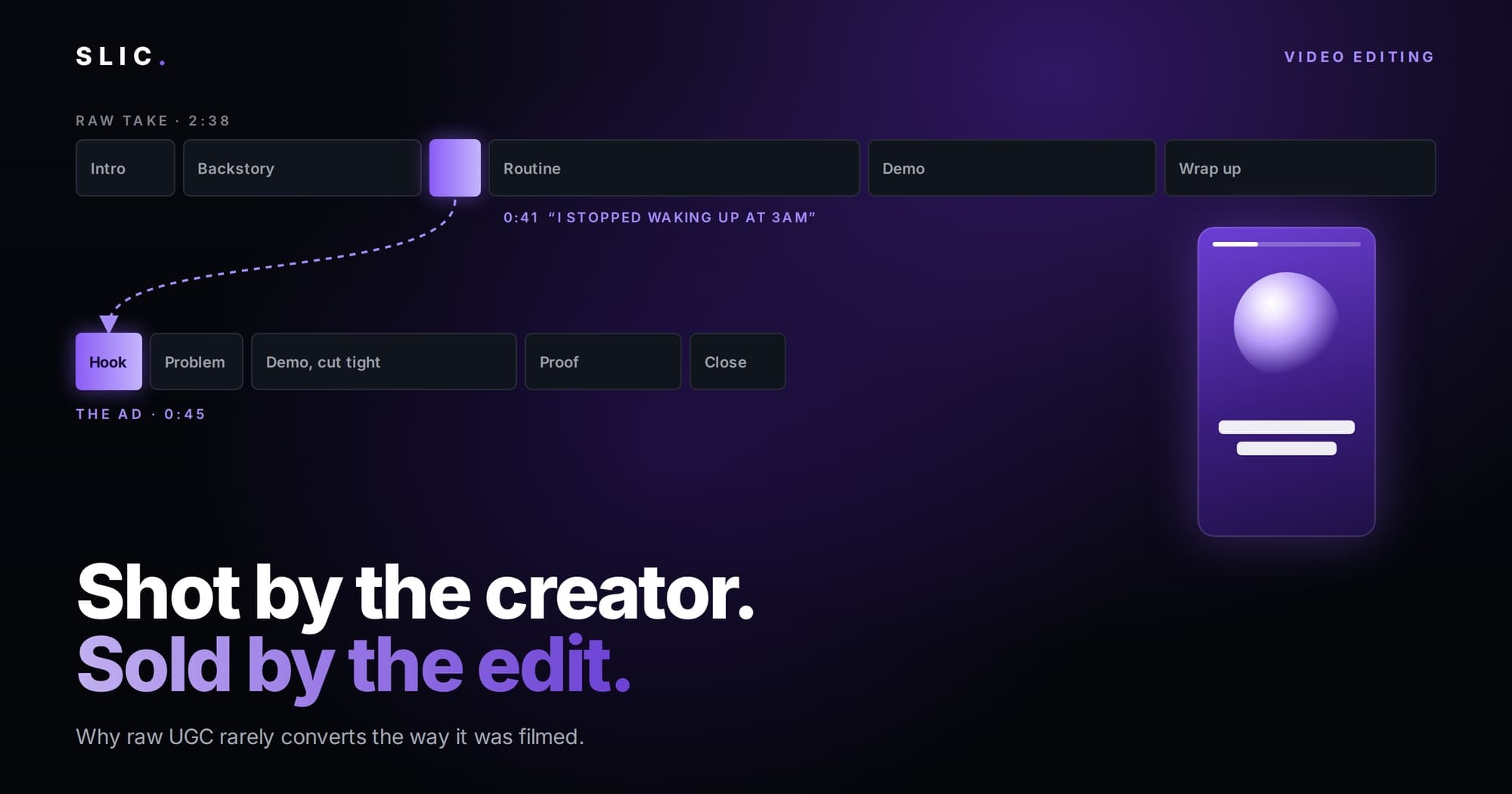
Most UGC that underperforms went out close to how it was filmed. Creators talk in the order they think of things: who they are, how they found the product, what they noticed, and eventually the line that would have stopped you scrolling. Buyers decide in a different order, and the edit is where one gets rebuilt into the other.
That's why two brands can hire the same creator, get similar footage and see completely different results. The difference usually gets decided after the camera's off.
What the creator gives you, and what they can't
A good creator gives you things that are hard to fake. A real face, a real kitchen or bathroom or car, and a way of talking that sounds like a person rather than a brand. Viewers are quick to spot a script being read, and a creator who's comfortable on camera gets past that filter in a way a polished brand video rarely does.
What they can't give you is structure. They don't know which of their lines converts, because they've never seen your account. They film for sound on, because that's how they watch. And they pace for a conversation, which is far slower than a thumb.
None of that is a criticism of creators. It's a different job, and it's the reason raw footage should be treated as material for an ad rather than as the ad itself.
Rebuild the opening instead of trimming it
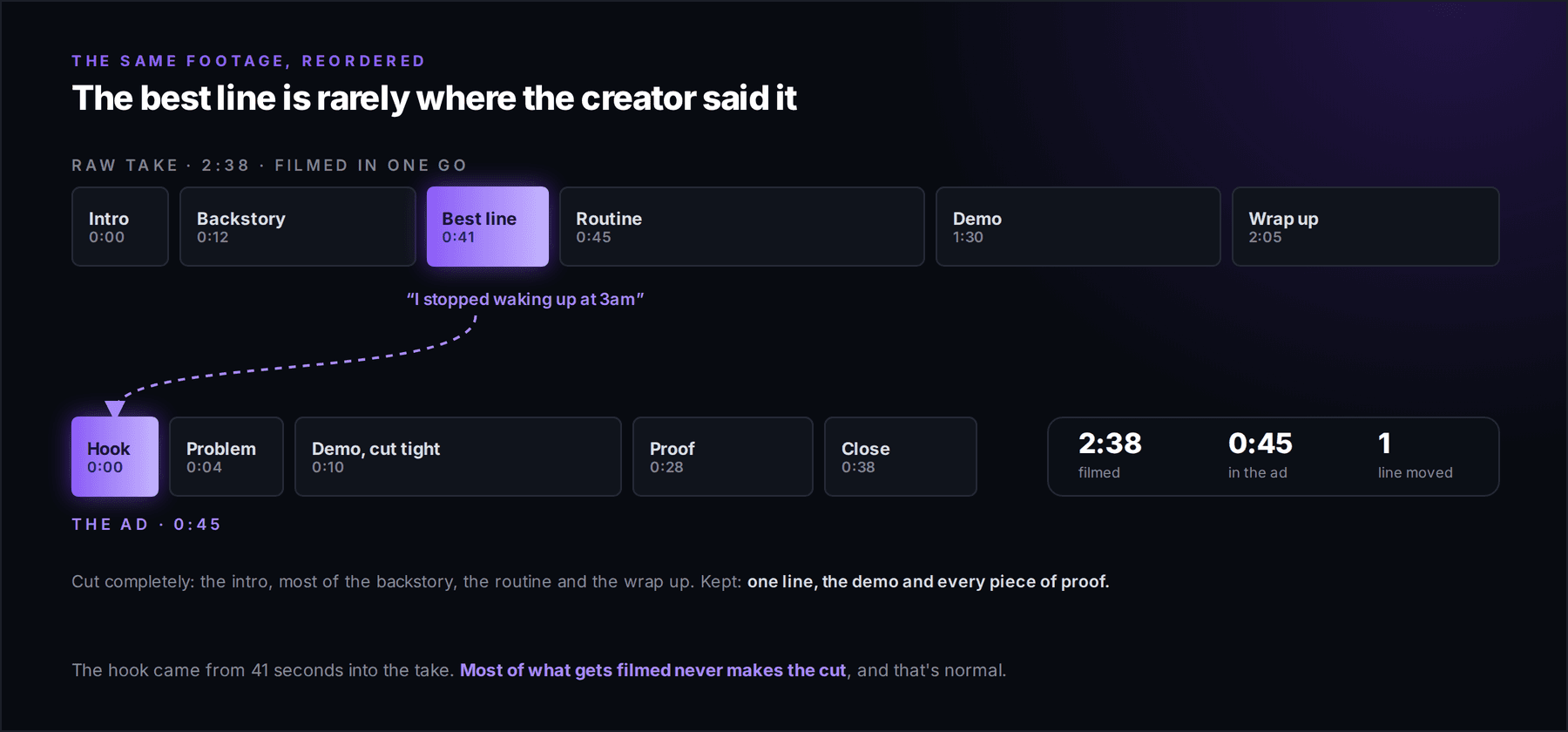
The strongest line in a creator take is almost never in the first five seconds. On a typical two or three minute take we'll find it somewhere past the half minute mark, often said almost in passing. Something like "I stopped waking up at 3am", buried after a minute of backstory.
That line becomes the opening. Most of the backstory goes. If the line needs context, the context comes after it, once you've already got the viewer's attention.
A few other things usually happen in the first second as well. The frame changes, so there's movement before anyone decides to scroll. The hook appears as text, so it works muted. And the creator is already mid sentence, because a breath and a smile before the first word is a second you don't get back. More on why that first stretch matters so much in why your hook dies at three seconds.
Cut the middle for proof
Once the opening has done its job, the viewer's question changes from "is this for me" to "is this real". The middle of the ad has to answer that, and filler works directly against it.
So the middle gets cut hard. Every "so", "honestly" and "and yeah" goes. Long talking sections get broken up with the product actually being used: close ups, the texture, the before and after, the result on a screen. When the creator makes a claim, the next shot should show it.
We'll also layer proof on top of the footage instead of saving it for later. A review, a number, the price, a comparison. A sceptical viewer who sees evidence while the creator's still talking stays longer than one who has to wait for the testimonial section.
One creator, five or six ads
This is where the edit earns its cost. A single well shot session can produce five or six distinct ads if the creator films with that in mind.
Ask for several different opening lines, each filmed as a clean take. Ask for the product in hand, in use and in its setting. Ask them to say the main claim three different ways. The edit can then pair each opening with the same proven middle, and you're testing hooks without paying for another shoot. The openings that tend to earn a place are in nine hook formats that still work on Meta.
If the creator only delivers one continuous take, you'll get one ad and a few trims of it. That's a briefing problem, and it's cheap to fix before the next shoot.
Sound off, so the text carries the argument
Plenty of people watch with the sound off, which means a UGC ad has to make sense as a silent film with subtitles. Auto captions won't get you there on their own. They transcribe everything, filler included, at whatever size the tool picked.
Working captions get edited like the footage. Fewer words, the key claim picked out, and nothing sitting where the platform's buttons will cover it. If you watch the ad muted and can still repeat the pitch back, the captions are doing their job.
How to tell whether the edit is the problem
When a UGC ad underperforms, the numbers usually tell you which part failed.
A low hook rate points at the opening. People aren't stopping, so the first line, the first frame or the text isn't landing. A decent hook rate with a poor hold rate points at the middle, and that's almost always an editing problem: too slow, too much talking, not enough proof. What good looks like for both is in hook rate and hold rate benchmarks.
If people are watching and clicking but not buying, look past the ad. The offer, the price or the landing page is more likely to be the issue than the creator.
Most brands respond to a weak UGC ad by booking a new creator. Re-cutting the footage they've already paid for is cheaper, faster and, more often than you'd expect, the actual fix.