Pull the retention graph on almost any underperforming video ad and you find the same shape: a cliff between 0:00 and 0:03. Most teams read that as an attention problem and answer it with more motion, louder music, faster cuts. It usually makes things worse.
It is not an attention problem. It is a promise problem.
What actually happens in the first three seconds
A viewer is not deciding whether your ad is interesting. They are deciding whether it is for them, and they finish deciding before they have consciously processed a single word.
Three questions get answered in that window:
- Is this about something I care about?
- Is the next ten seconds going to be worth it?
- Do I already know how this ends?
A hook fails when the first two are unclear, or when the answer to the third is yes.
The four ways hooks die
The logo opening. An ad that starts with a brand sting has spent its most valuable second announcing that it is an ad. You have not earned that second yet.
The slow build. Cinematic openers work when someone chose to watch. Nobody chose to watch your ad. A shot that establishes mood before it establishes subject is a shot that gets scrolled.
The unearned claim. "The best one you will ever own" answers question three immediately. Yes, I know how this ends. It ends with you selling me something.
The wrong specificity. Generic openings fail question one. "Tired of back pain?" targets everyone and lands on nobody. "If you sit at a desk more than six hours a day" targets fewer people and holds far more of them.
What holds attention instead
A hook works when it opens a gap the viewer wants closed.
Lead with the problem in their words. Not your description of it. The phrasing an actual customer used in a review. Mine your own reviews for the exact sentence.
Show the thing immediately. If the product is visually interesting, the product is the hook. Do not narrate towards it.
Start mid story. Cut the setup. Open at the point of tension and let the viewer reconstruct the rest.
Contradict an expectation. A statement that conflicts with what the viewer already believes forces them to stay for the resolution.
How to diagnose your own ads
Open the retention graph and look at where the drop happens, not how big it is.
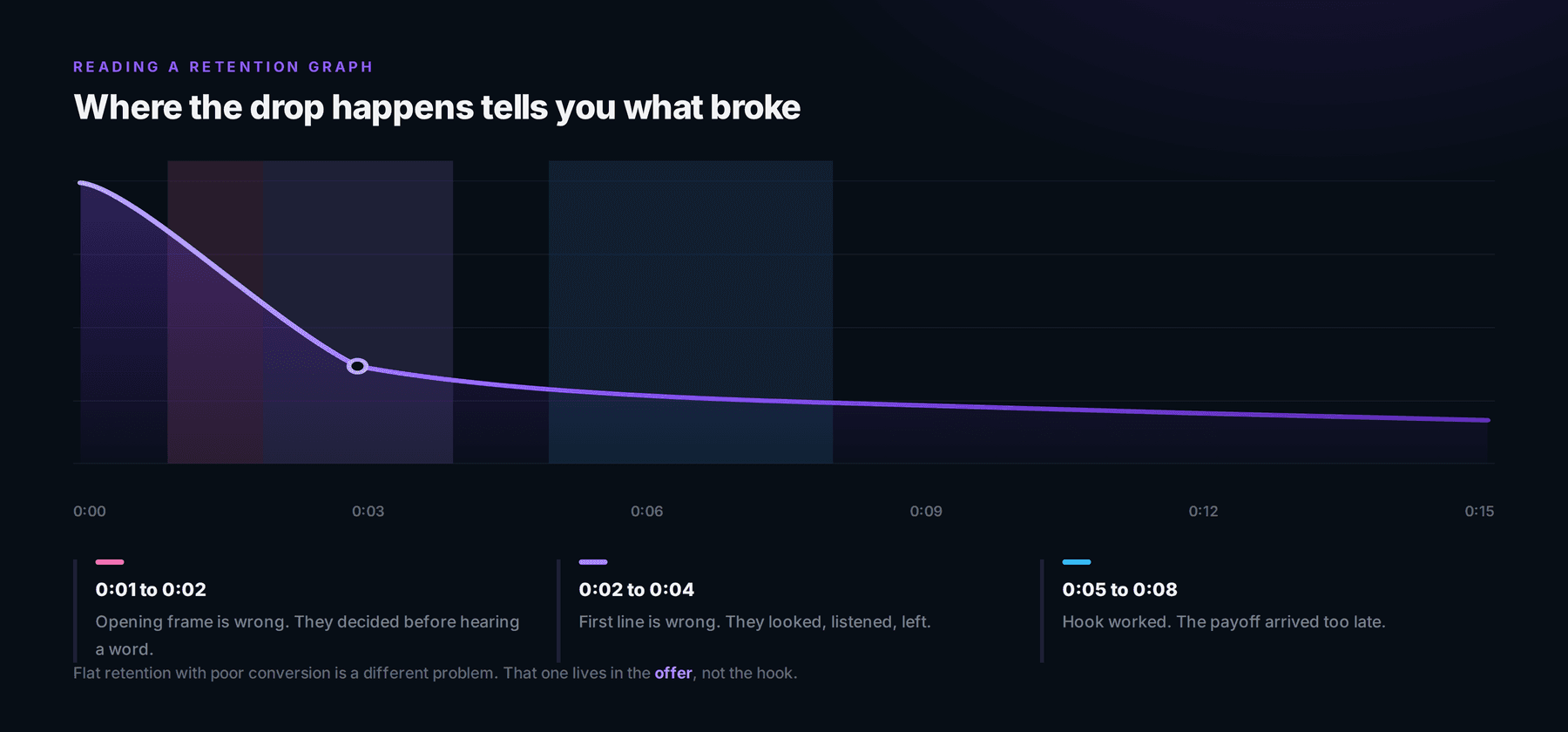
Drop at 0:01 to 0:02. The opening frame is wrong. This is composition and subject, not script. They decided before hearing anything.
Drop at 0:02 to 0:04. The first line is wrong. They looked, they listened, they were not convinced it was for them.
Drop at 0:05 to 0:08. The hook worked and the payoff arrived too late. You opened a gap and took too long to close it.
Flat retention, poor conversion. The ad held attention and did not sell. Different problem entirely, and it lives in the offer and the CTA, not the hook.
The test that costs almost nothing
Take a winning ad and re-cut it with three different opening three seconds. Same body, same CTA, same everything after 0:03.
If the three perform within a few percent of each other, the hook is not your bottleneck and you should be testing concepts instead. If they spread widely, you have found the cheapest lever in the account.
We run this on every account before producing anything new. It is often the difference between rebuilding a campaign and re-cutting three seconds.