A hook is not an attention grabber. It is a promise specific enough that the right person feels obligated to stay and the wrong person leaves immediately. The second half of that sentence is the part most brands skip, and it is the reason so many high energy openings produce nothing.
Here are nine formats that consistently earn their place in a testing batch, what each one is for, and where each one fails.
1. The direct callout
Name the person and the problem in the first line. "If your knees hurt on stairs, this is for you."
Works when your audience self identifies with a specific, uncomfortable problem. Filters hard, which is the point.
Fails when the problem is vague or aspirational. "If you want to feel better" identifies nobody.
2. The contradiction
State something the viewer believes, then reject it. "Drinking more water is not why you are tired."
Works when the belief is genuinely common and your product is the resolution. The tension is what buys you the next eight seconds.
Fails when the contradiction is manufactured. Viewers can tell within a second, and the credibility cost carries into everything that follows.
3. The demonstration cold open
No talking. Show the product doing the single most surprising thing it does, in frame one.
Works when the product has a visible, immediate transformation. Cleaning, repair, assembly, before and after.
Fails when the benefit is invisible. Supplements, software, most services. Showing a bottle is not a demonstration.
4. The number
Open on a specific figure. "We tested 40 of these. Three were worth buying."
Works when the number is odd and specific. Specificity reads as research. Round numbers read as marketing.
Fails when the number is about you rather than them. Nobody stayed for a company milestone.
5. The mistake
Show the wrong way first. "You are storing these completely wrong."
Works when the mistake is one the viewer is probably making right now. Mild accusation creates a genuine need to know.
Fails when it tips into condescension. There is a narrow line between "you might not know this" and "you are an idiot", and the second one converts nobody.
6. The comparison
Two options in frame, one obviously better. Often silent, often just hands.
Works when the difference is visible in under two seconds. Comparison is the fastest way to communicate value with no words at all.
Fails when the viewer has no context for which one is better. If you have to explain the comparison, it is not a hook, it is a lesson.
7. The overheard opinion
Open mid sentence, as if the camera arrived late. "and that is why I stopped buying the expensive one."
Works when it feels genuinely unpolished. The format borrows credibility from feeling unproduced.
Fails when the production quality contradicts it. A cinematic grade on an overheard opinion reads as a performance, because it is one.
8. The stakes
Name the cost of not acting. "Most people replace these every eight months. That is $400 a year."
Works when the cost is concrete and calculable. Money, time, or repeated frustration.
Fails when the stakes are inflated. Overstate them and you trigger scepticism instead of concern.
9. The question you already know the answer to
Ask something the viewer will answer internally before you finish. "Why does your back hurt worse after a day off?"
Works when the question is genuinely puzzling and your product resolves it. The viewer stays because they want their guess confirmed.
Fails when the question is rhetorical filler. "Want better skin?" is not a question, it is a pause.
The rule underneath all nine
Every format above works for the same reason. It opens a specific gap between what the viewer knows and what they want to know, and the rest of the ad closes it.
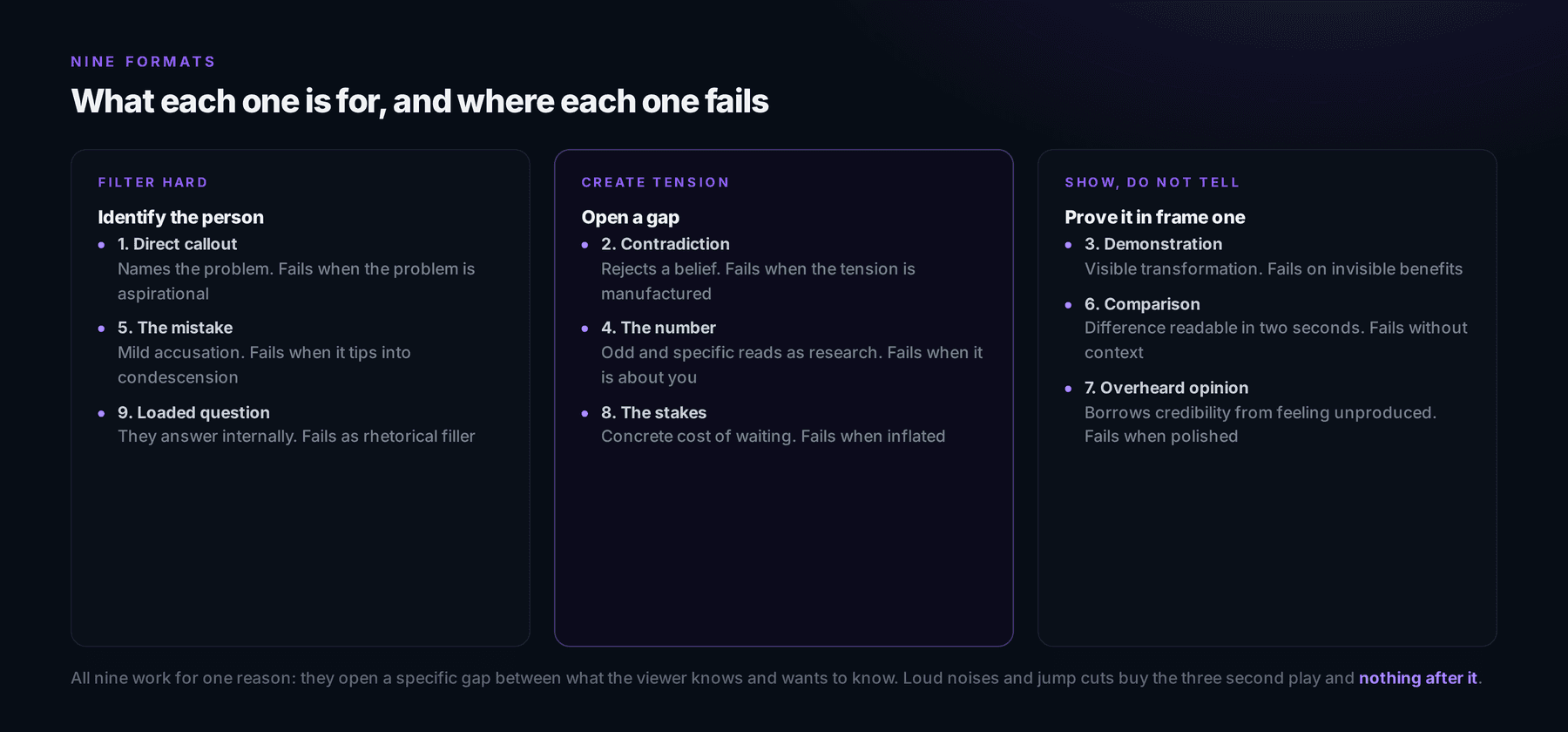
Formats that do not work fail for the same reason too. Loud noises, jump cuts, cash on a table and someone shouting all get the three second play. None of them create a gap, so the hold rate collapses the moment the noise stops. That distinction between a hook that grabs and a hook that promises is the entire subject of why your hook dies at three seconds.
How to test them without wasting a month
Do not test nine hooks on one concept. Test two hooks each across four or five concepts. You learn which idea has legs and which opening suits it at the same time, for the same money.
Then take the winning concept and run three more hooks against it. That second round is where most of the gain is, and almost nobody runs it because the first round already produced something that worked.
The volume maths behind that split is in how many ad creatives you should test each month.