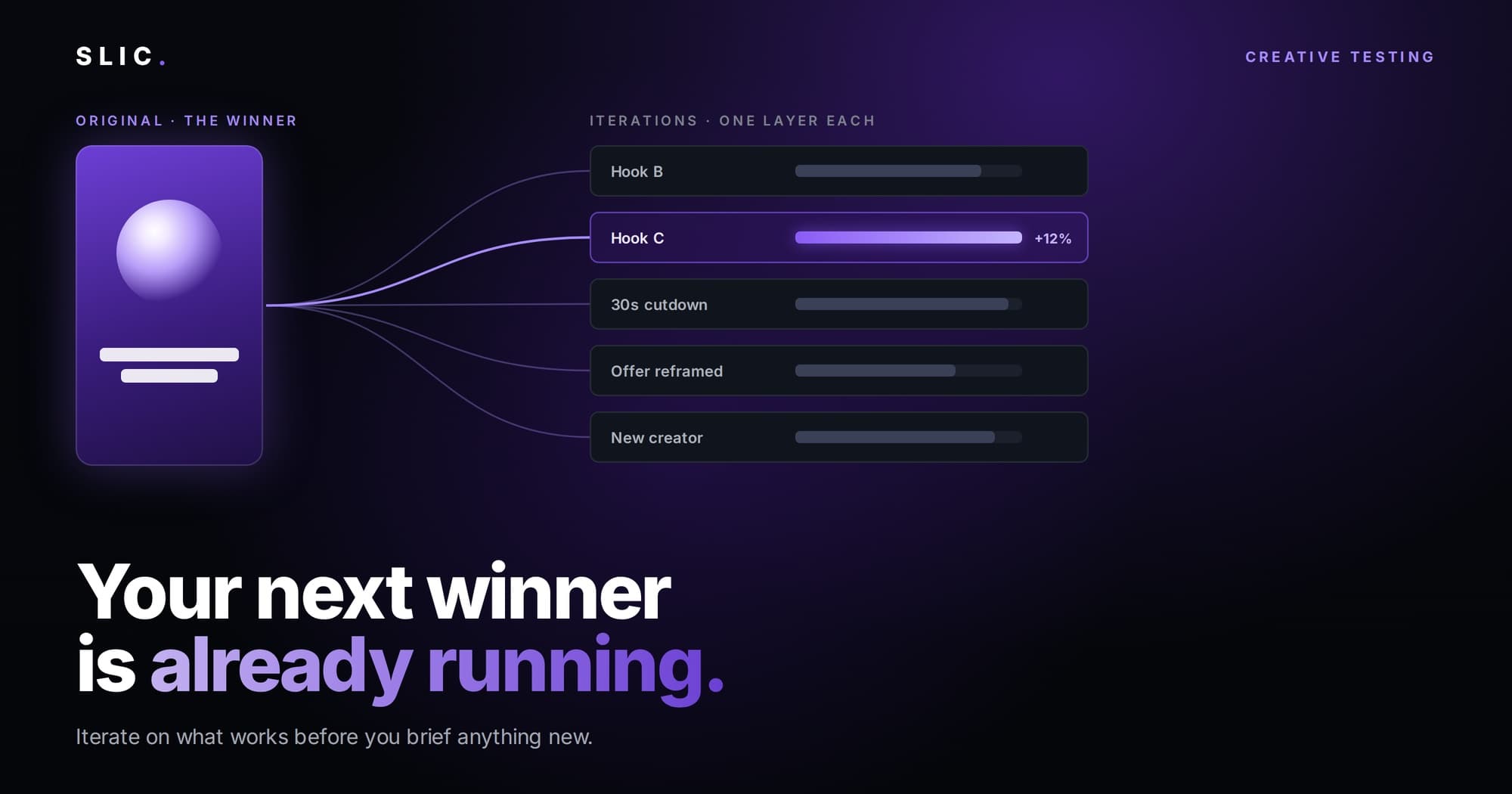
The cheapest winning ad you'll make this quarter is probably a variation of one that's already working. Most brands find a winner, scale it, then go straight back to briefing brand new concepts. That throws away the most useful thing in the account: an ad that's proven the audience responds to a particular argument.
Work out why it won before you touch it
An ad can win for very different reasons, and each one points at a different iteration.
If the hook rate is well above your account average, the opening is doing the heavy lifting. If hook rate is ordinary but hold rate is strong, the middle is what's working, usually the demonstration or the proof. If both are normal but the ad converts better than anything else, the offer or the specific claim is probably the reason. How to read those numbers is in the five numbers that tell you if a creative is working.
Whatever's outperforming is the part you protect. Everything else is fair game.
Change one layer at a time
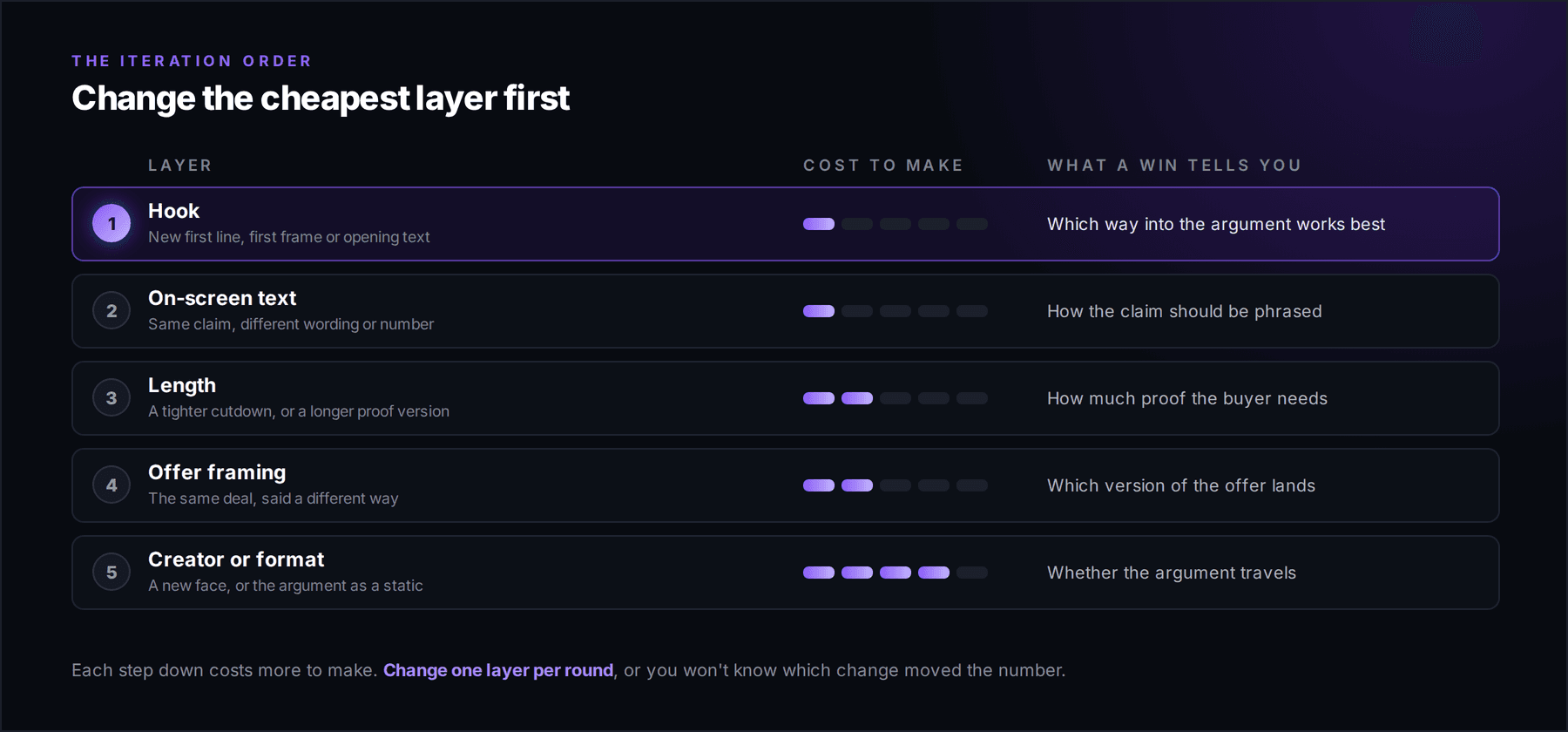
We iterate in a fixed order, starting with whatever's cheapest to produce and quickest to read.
The hook. New first line, new first frame, new opening text. Same body underneath.
The on-screen text. Different wording of the same claim, a different emphasis, a different number pulled forward.
The length. A tighter cutdown and, if the original is short, a longer version with more proof in it.
The framing of the offer. Same deal, said differently. "Save $40" and "two months free" can perform very differently even when they're worth the same.
The person or the format. A different creator delivering the same script, or the same argument as a static or a carousel.
Change two layers at once and you can't tell which one moved the number. It looks slower on paper and it's much faster in practice, because every result actually teaches you something.
Start with hooks
Hooks are the cheapest test with the biggest swing. If you already have the body, a new opening is a short editing job and, at most, a few extra lines from the creator.
Three to five new hooks on a proven body is a good first round. If one of them beats the original, you've found a better way into the same argument and you can scale that version. If none of them do, that's useful too. It tells you the original opening was a big part of why the ad won.
What a round looks like in practice
The order above is a default. If the original's opening is the reason it won, protect it and start one layer down.
Say a UGC ad has a hook rate of 38 percent against an account average of about 26, and an ordinary hold rate. The opening is doing the work, so the first round keeps it and tests what sits behind it: a tighter 30 second cut, a version with the reviews pulled forward into the middle, and the same opening line delivered by a second creator. If the tighter cut wins, the next round tries two new hooks on that cut, written in the same style as the original, to find out whether it was the line itself or the kind of line that worked.
The opposite case is just as common. A strong hold rate with an ordinary hook rate means the people who stop tend to stay, so the first round is all hooks. Four new openings on the same body, and nothing else changed.
Know when the angle is used up
At some point variations stop beating the original. New hooks, new lengths and new creators all land a little below it. That usually means the angle itself has run its course for now, and the next winner will be a different argument rather than another version of this one.
Keep the proof, though. The demonstration, the results and the reviews that worked here will often work just as well behind a completely different hook and claim.
Test iterations in the testing campaign
It's tempting to drop a variation straight into the scaling campaign next to the original. Don't. The new version is up against an ad with weeks of delivery history, it rarely gets a fair share of spend, and you've added an untested ad to your most expensive campaign.
Iterations go through the same testing campaign as any new concept, and the winners get promoted. The setup is laid out in how to structure a Meta account around creative, and moving a winner across without resetting it is covered in how to scale a winning creative without killing it.
Keep a record of what each round taught you
Name every iteration so the account shows what changed. Something like concept, claim, layer changed and version number. Six months from now, "hook three on the durability ad beat the original by a third" is worth far more than a folder of files called final_v7.
That record is also what makes the next brief better. After a few rounds you stop guessing which openings work for your customer, because you've got the results written down.