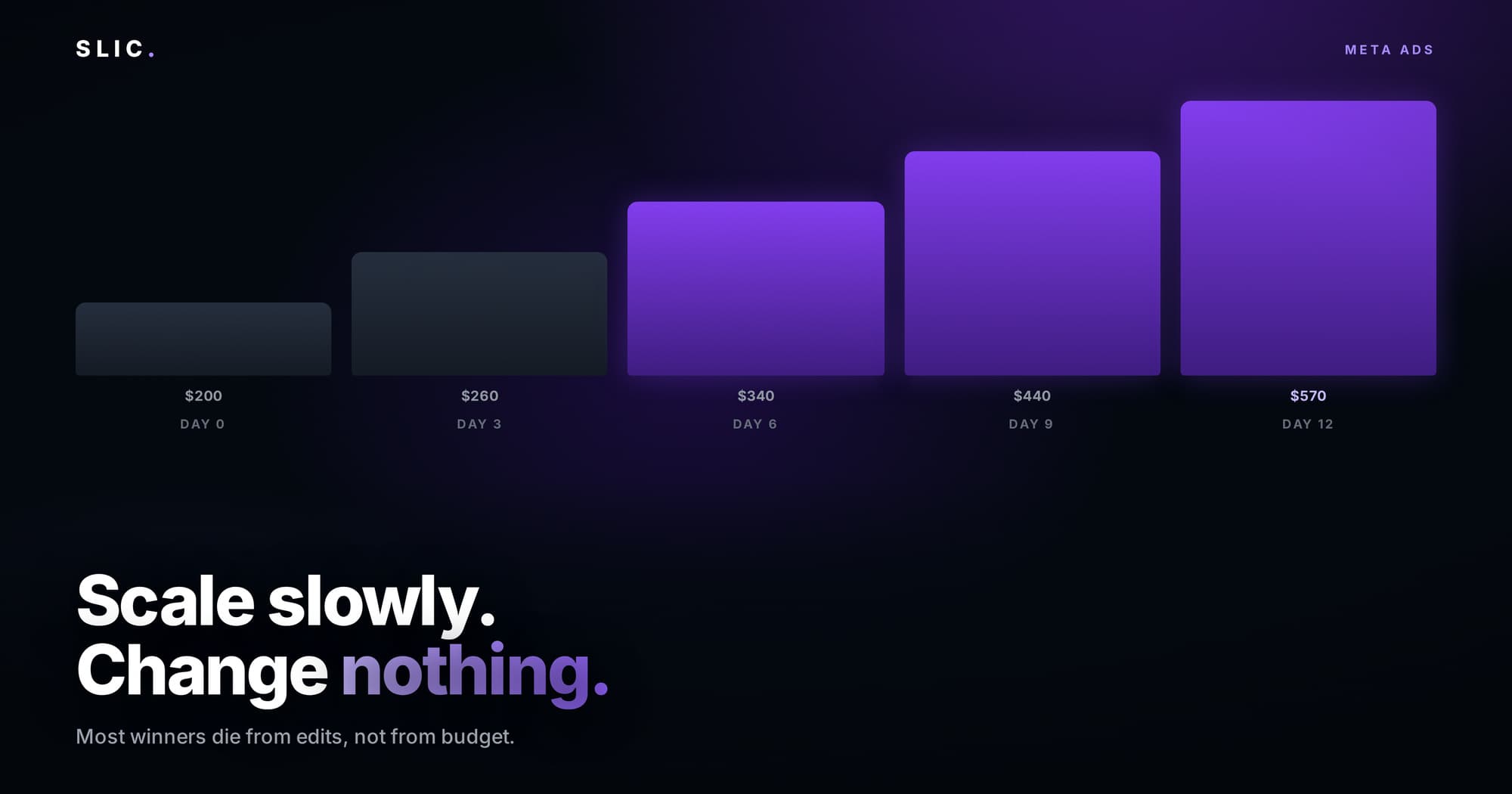
Scale a winner by increasing budget 20 to 30 percent every two to three days, in the campaign it already lives in, without editing the ad. Most winners are not killed by scale. They are killed by the changes people make while scaling them.
The instinct when something works is to improve it and push hard. Both instincts are wrong at exactly this moment.
Why aggressive budget jumps break things
A large budget increase resets delivery optimisation. The system has to re-find who responds at the new spend level, and during that window your cost per result rises for reasons unrelated to the creative.
Most people read that rise as the ad failing, panic, and pull the budget back down. Now delivery resets again, in the other direction. Two resets in a week and a genuinely good ad looks unstable, gets rested, and never recovers.
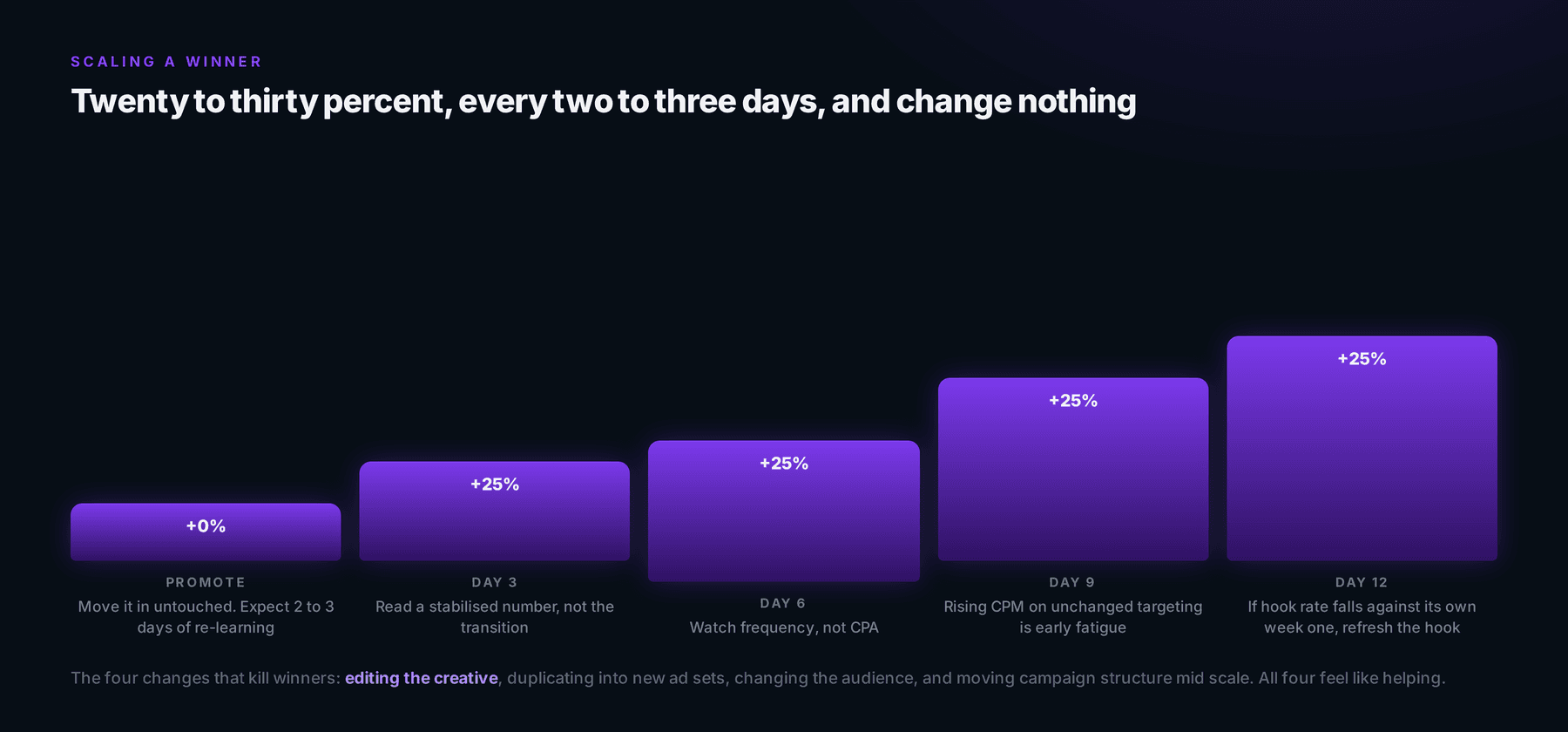
The 20 to 30 percent step size exists to stay inside the tolerance where re-learning is minor. Wait two to three days between steps so you are reading a stabilised number rather than the transition.
The four changes that kill winners
Editing the creative. New thumbnail, tighter cut, different CTA. Every one of these means the thing you are now scaling is not the thing that won. If you want to improve it, run the improvement as a variant alongside the original and let the data decide.
Duplicating into new ad sets. Sometimes justified, frequently not. Duplicates compete with the original in the same auction, which raises your own costs against yourself. The account looks busier and performs worse.
Changing the audience. Adding interests, swapping lookalikes, tightening exclusions. Now you have changed two variables at once and cannot attribute the result to either.
Moving it to a new campaign structure mid scale. Full reset of everything the ad has learned. If it has to move, move it once, early, and expect three days of noise.
What to watch on the way up
Three numbers, in this order.
- Frequency. Climbing past 2.5 to 3 on prospecting means you are running out of responsive audience, not that the creative failed. That is an expansion problem.
- Hook rate against its own first week. Falling hook rate at higher spend is early fatigue and it appears well before CPA moves.
- CPM. Rising CPM on unchanged targeting means the auction is charging you more to keep serving a tiring ad.
The full signature of fatigue, and how to tell it apart from seasonality and audience saturation, is in creative fatigue: spot it before your CPA does.
The ceiling nobody warns you about
Every creative has a maximum spend level where it still works, and it is a property of the ad, not of your account.
A concept that speaks precisely to one segment will produce excellent numbers at $500 a day and fall apart at $3,000, because the segment it speaks to is finite. Broader concepts scale further and often start weaker. This is the single most useful thing to know about your own winners and it is only learnable by scaling them.
When you hit the ceiling, the answer is not more budget on the same ad. It is a new concept aimed at a different segment. Recognising that early saves weeks of pushing against a wall.
Extending a winner's life
Once an ad is genuinely scaling, three moves buy more out of it, in ascending order of cost.
- Hook refresh. Same ad, new opening two seconds. Fatigue attaches to the recognisable opening frame more than to the body. Cheapest available move and it works surprisingly often.
- Format cuts. A 15 second version for Reels, a square version for Feed. Same footage, new placements, incremental reach.
- Concept extension. Same argument, different execution. A new setting, a new speaker, the same claim. Reaches people the original did not.
All three depend on having the project files and having briefed the original with iteration in mind. If a hook refresh means going back to the vendor and paying full price for a new asset, you will not do it, and the winner will die earlier than it needed to.
The rule
Scale slowly, change nothing, and watch frequency rather than CPA. Everything expensive that happens during scaling happens because somebody could not leave a working ad alone.