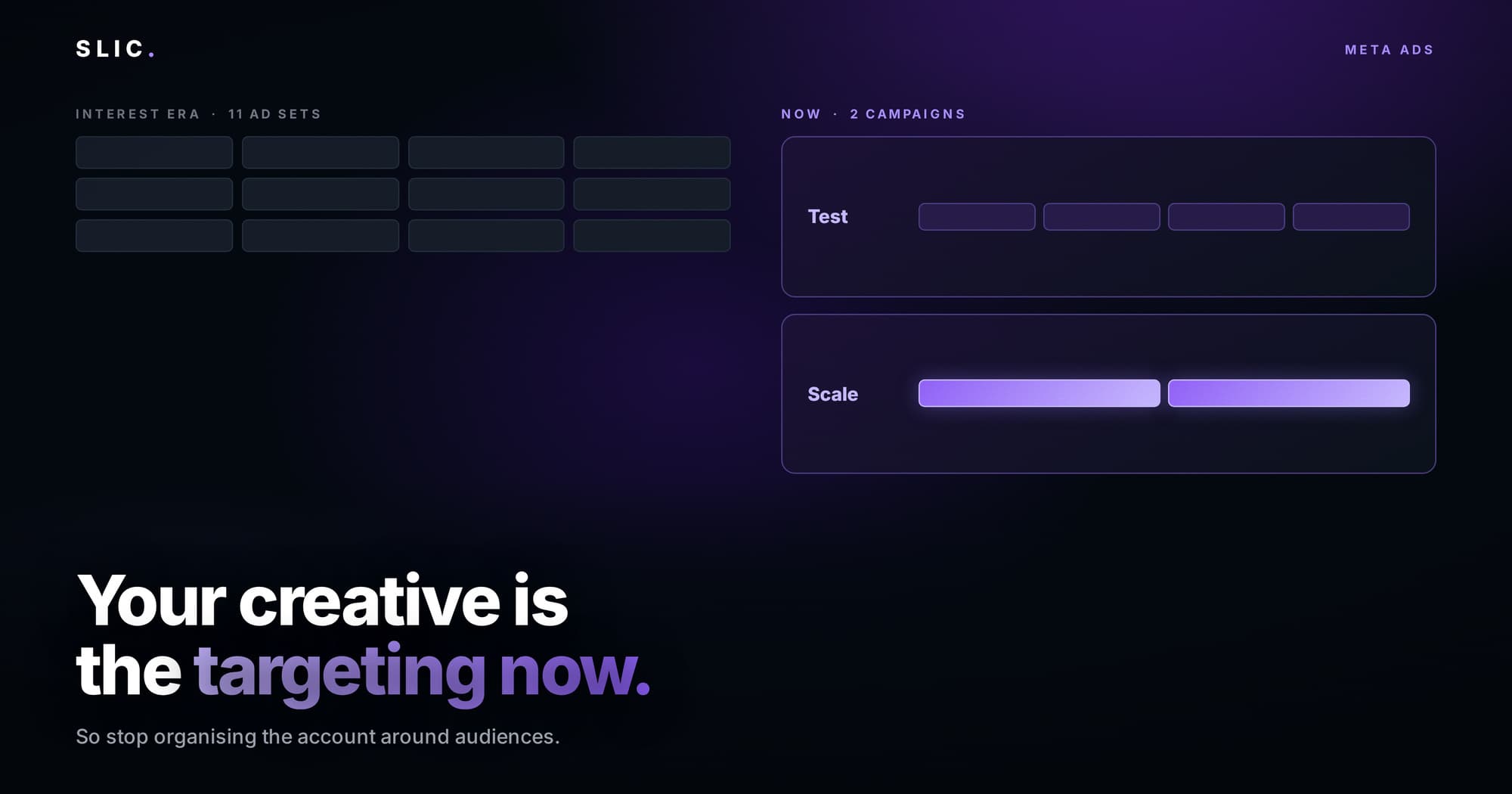
If broad targeting is doing the work, your creative is the targeting. Which means the account should be organised around what you're testing, not around who you're aiming at. Most accounts still aren't, and it costs learning speed.
Audience-led structure made sense when you could actually buy a narrow slice of people. Advantage+ and broad delivery took most of that away. What's left is a system that finds the audience for you, based on who responds to the creative you gave it.
What the old structure was for
The interest-stack era had a logic to it. You'd split ad sets by interest, lookalike percentage and cold versus warm, and read which slice performed. The creative was roughly constant and the audience was the variable.
That reads backwards now. Broad delivery with a good signal will out-deliver a hand-built interest stack most of the time, and when it does, every audience split you're maintaining is just fragmenting your conversion data across more ad sets than any of them can fill.
The tell is simple. If you can't remember the last time an audience test changed a decision, you're maintaining structure out of habit.
The structure that works now
Two campaigns. That's genuinely it.
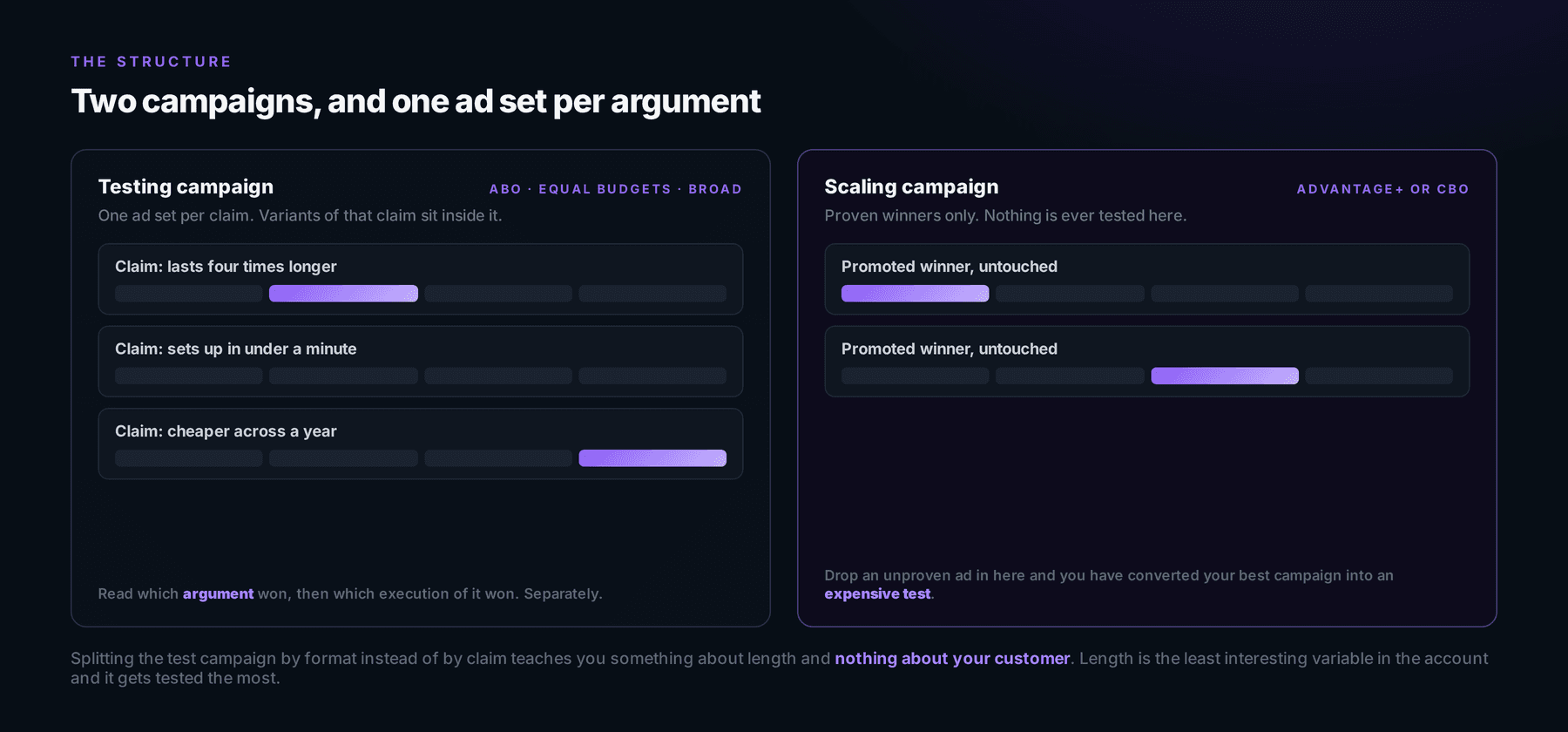
A testing campaign, ABO, one ad set per concept, equal budgets, broad. Equal budgets matter, because the moment you let the system allocate you're measuring what looked good on day one rather than what holds up over a week.
A scaling campaign, Advantage+ or CBO, proven winners only. Nothing gets tested here. Drop an unproven ad into your best campaign to see what happens and you've converted it into an expensive test.
Everything else people add, the exclusion layers, the lookalike ladders, the eleven ad sets, is usually there because somebody wanted the account to look considered. It costs learning speed and buys close to nothing.
Organise the test campaign by argument
Here's the part most teams skip. One ad set per concept means one ad set per claim, not per format.
So if you're testing whether the audience cares about durability, speed or price, that's three ad sets. Inside each one sit the variants of that claim: two hooks, a shorter cut, a different CTA. Now when you read the account you can see which argument won, and separately which execution of it won.
Split by format instead, with all your 15 second cuts in one ad set and your 30s in another, and you'll learn something about length and nothing about what your customer actually responds to. Length is the least interesting variable in the account and it gets tested constantly because it's easy.
Naming, because it decides whether anyone can read the account in six months
Use a convention that survives a new hire. Something like concept / claim / variant / date, so an ad name says what it argued and which version it was.
The test is whether you can answer "what did we prove about this customer last quarter" by looking at the account. If the answer requires someone who was there at the time, the naming has failed and so has the record.
How many ad sets can you actually afford
This is where structure meets arithmetic and where most plans fall over.
Each ad set needs enough conversions to be readable. If your CPA is $40 and you want fifty conversions per concept to call it, that's $2,000 of spend per ad set. Six concepts is $12,000. If your monthly test budget is $4,000, you can afford two concepts properly or six badly.
Six badly is the common choice and it produces an account full of numbers that don't mean anything. Two properly is the better trade almost every time. How to size that budget honestly is in how much of your budget should go to creative testing.
When audience splits still earn their place
Three cases, and they're narrower than most accounts assume.
Retargeting. Genuinely different creative job, genuinely different economics, and it should be a separate campaign with its own thresholds.
Geography with real differences. Different language, different price, different offer. Not different postcode.
A product line with a distinct buyer. If the person buying your $30 product has nothing in common with the person buying the $400 one, splitting is honest.
Outside those, the audience split is usually a habit rather than a decision.
If you're restructuring an existing account
Don't do it all at once. Rebuild the test campaign first, leave the scaling campaigns alone, and run both structures side by side for a few weeks.
Everything in a scaling campaign has delivery history you'd be throwing away, and re-learning at high spend is expensive. Migrate winners one at a time, and expect two or three days of noise each time you move one. That behaviour is covered in how to scale a winning creative without killing it.
The weekly decision loop that sits on top of this structure is in the Meta creative testing framework.