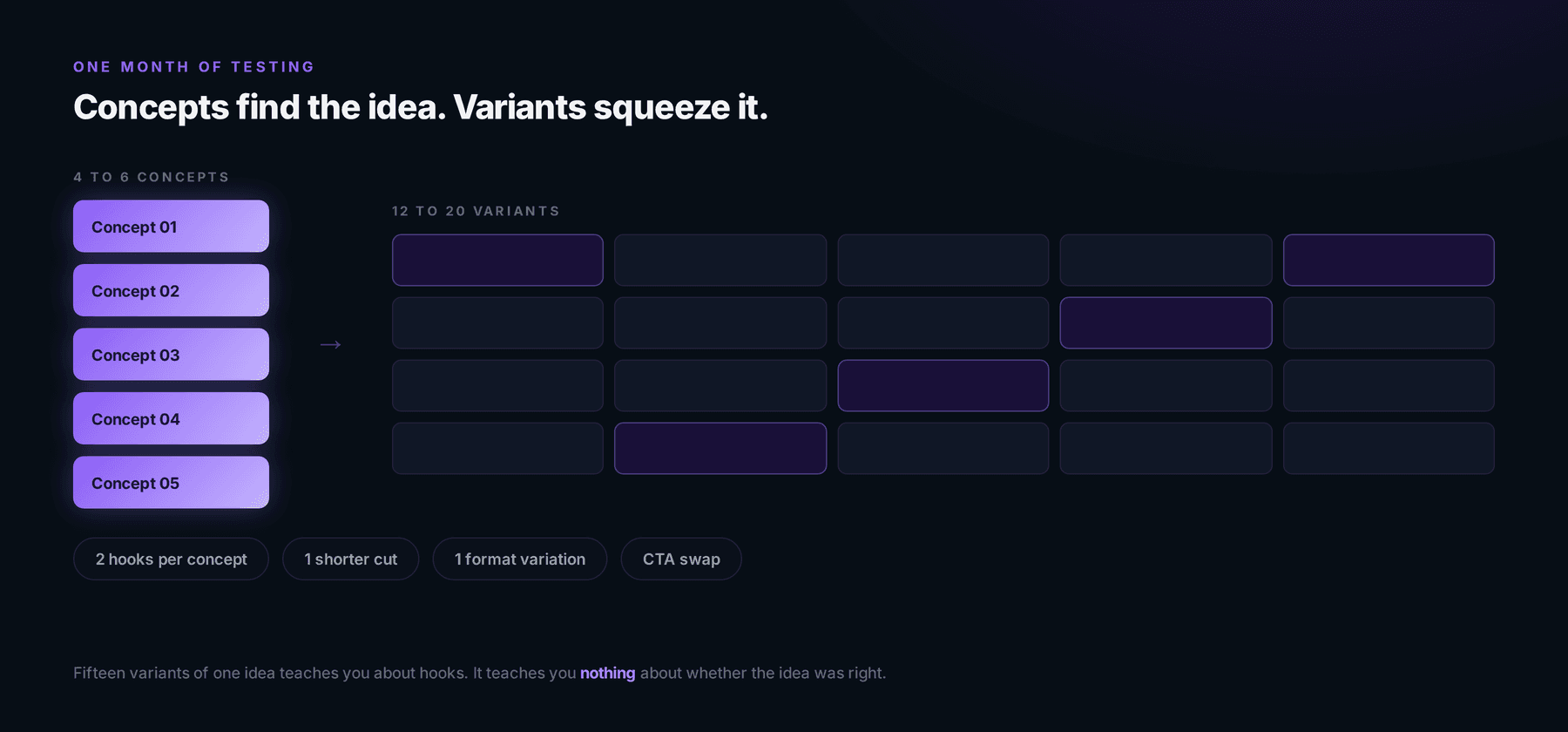
Short answer: 4 to 6 distinct concepts a month, broken into 12 to 20 variants. Below that you cannot separate a bad idea from bad luck. Above it, most teams cannot produce fast enough to hold quality.
That range assumes $30,000 or more a month in paid social. Spend less and the maths changes, which we get to at the end.
Why concepts and variants are not the same thing
A concept is an idea: a claim, an angle, a reason to buy. "It fits in your front pocket" is a concept. So is "the one you own now is wrecking your back pocket."
A variant is one execution of that concept. A different hook, a different length, a different aspect ratio, a different CTA.
Most brands confuse the two and end up running fifteen variants of a single idea. They learn a lot about which hook works and nothing about whether the idea was right in the first place. If a concept is wrong, no amount of re-cutting rescues it.
Test concepts to find the idea. Test variants to squeeze it.
Why 4 to 6 concepts
Creative testing is a hit rate game. Across DTC accounts, somewhere between one in five and one in ten concepts becomes a genuine winner that can carry real spend.
Run two concepts a month and an ordinary run of bad luck is indistinguishable from a broken process. Run six and you get a readable signal inside a month. That is the whole argument for the number.
Why 12 to 20 variants
Once a concept is live you need enough executions to know whether it failed on the idea or on the delivery.
Three to four variants per concept usually covers it:
- Two hooks, because the first three seconds decide most of the outcome
- One length variation, normally a shorter cut
- One format variation for placement
Twenty variants across five concepts gives every idea a fair test without flooding the account.
What goes wrong if you test less
Under roughly eight variants a month, three things break.
Learning stalls. You are making calls on samples too small to mean anything, which usually means killing winners early and keeping losers too long.
Fatigue outruns you. A winning ad at scale typically starts decaying inside two to four weeks. If your production cycle is slower than your fatigue cycle, CPA climbs and you have nothing ready to replace it.
You iterate on the wrong thing. With no fresh concepts, teams re-cut the last winner repeatedly, chasing smaller and smaller gains from an idea that is already tired.
What goes wrong if you test more
More is not automatically better. Past about 25 variants a month most teams hit one of two walls.
Budget fragmentation. Each ad gets too little spend to exit the learning phase, so nothing gets a clean read.
Quality drops. Volume comes out of research time, and volume without research is just guessing faster.
How to work out your own number
Work backwards from spend, not from ambition.
- Take your monthly paid social budget
- Decide the minimum spend an ad needs to give a reliable signal, usually 3 to 5 times your target CPA
- Divide
If your target CPA is $40, an ad needs roughly $120 to $200 behind it before it tells you anything. At $30,000 a month with 60% going to testing, that is around 90 to 150 ad slots of budget. Twenty variants sits comfortably inside that. Fifty does not.
The number that actually matters
Volume is a means, not the goal. What you are really buying is cycle time: how fast a finding becomes the next batch.
A team testing 12 variants that turns learnings around in 72 hours beats a team testing 40 on a four week cycle, every time. The second team is producing more and learning slower.
Where this fits
Volume is one input. The system it feeds is the other, and the two campaign structure that makes weekly testing survive a real account is in the Meta creative testing framework.
Two things decide whether the volume teaches you anything. The first is judging each ad on the right number, which is why ROAS, CPA and MER are not interchangeable. The second is the brief, because concept volume collapses into variant volume the moment nobody writes the claim down. Six fields fix that.
At SLIC we ship 4 to 6 concepts and 12 to 20 variants a month, with new variants live 48 to 72 hours after a finding. If your creative is the bottleneck rather than your funnel, book a strategy call and we will show you what your current batch is missing.