
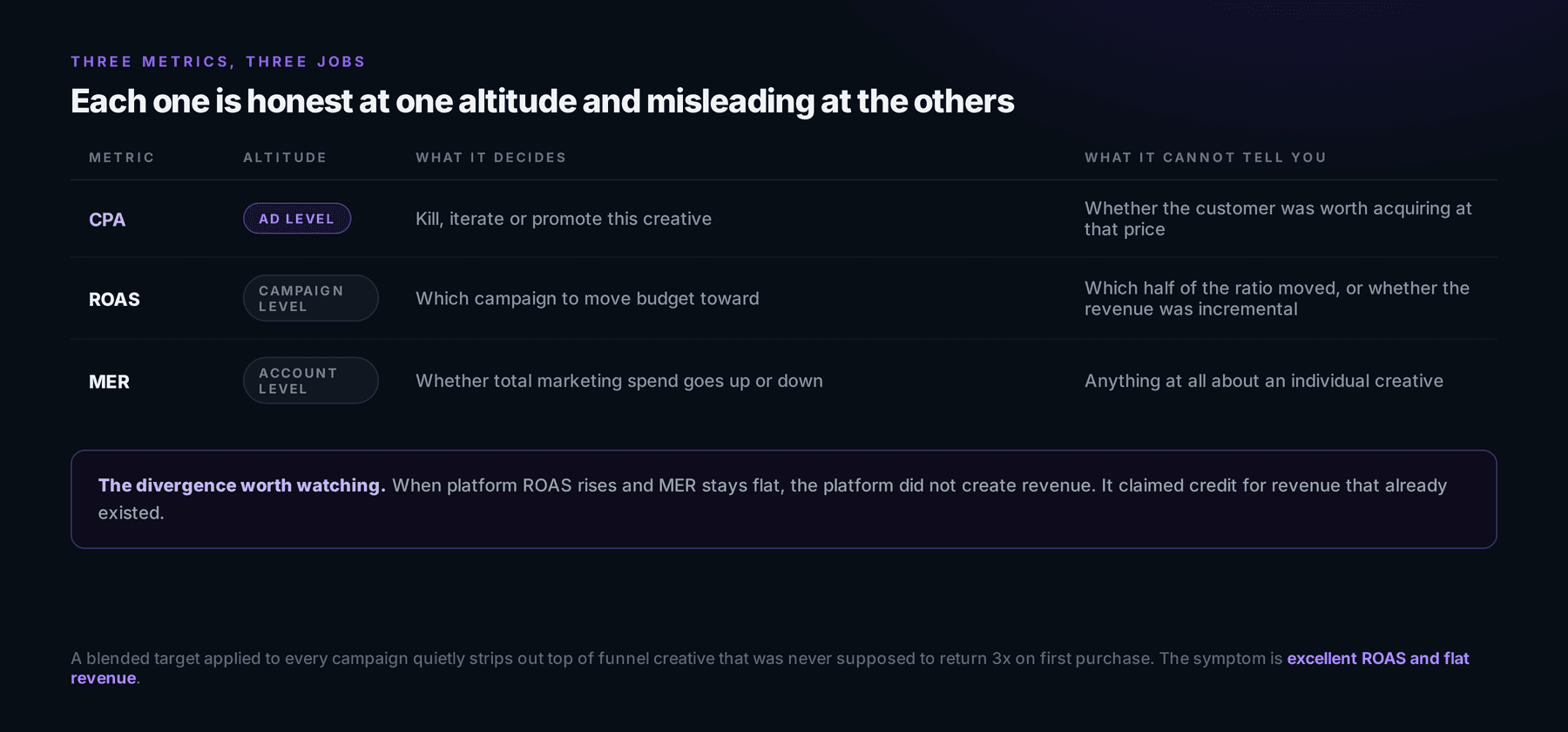
Judge individual creatives on CPA. Judge the account on MER. Use ROAS to compare, never to decide. Most teams do the opposite and then argue about why the numbers disagree.
The three metrics are not competing versions of the same truth. They answer different questions at different altitudes, and using one at the wrong altitude is how creative decisions get made badly for months without anyone noticing.
What each one actually measures
CPA is what it cost to buy one conversion. It is the only one of the three that is genuinely about the ad, because it is not affected by how much the person spent afterwards.
ROAS is revenue divided by ad spend, inside the platform, using the platform's own attribution. It is a ratio, which means it moves when either number moves, which means a ROAS change never tells you which one did.
MER is total revenue divided by total marketing spend, across everything, measured at the business level. It is the only one that survives an attribution change, and the only one your accountant recognises.
Why ROAS is a bad judge of creative
Two ads, same offer, same audience. Ad A returns 2.8x. Ad B returns 3.4x. Obvious answer, until you look at what is underneath.
Ad B might be pulling a smaller, higher intent slice of the audience who were going to buy anyway. It looks efficient because it is barely doing any work. Ad A might be bringing in genuinely new customers at slightly lower immediate return and higher lifetime value.
Scale Ad B and it collapses, because the intent slice it fed on is finite. This happens constantly and it is one of the most expensive mistakes in creative selection, because the metric was pointing at the answer the whole time and the metric was wrong.
ROAS also moves with average order value, with discounting, with which products the ad happened to feature, and with the attribution window. None of those are creative decisions. All of them change ROAS.
Why CPA is the right judge at the ad level
CPA isolates the thing you can actually control with a video. Did this creative persuade more people to convert, per dollar, than the other creative did.
It has one weakness worth stating. It ignores order value entirely. An ad that sells the $30 product at $12 CPA looks better than one selling the $180 bundle at $40 CPA, and the second one is obviously more valuable.
The fix is not to abandon CPA. It is to segment. Compare creatives that push the same product or the same price tier against each other, and compare across tiers using contribution margin instead. Every serious account ends up doing some version of this.
Why MER is the only account level truth
Platform ROAS is self reported by the party selling you the ads, using an attribution model you cannot audit. That does not make it useless, it makes it a directional signal.
MER has none of that problem. Total revenue over total spend cannot be inflated by attribution changes, iOS updates, or a modelling adjustment shipped on a Tuesday. When platform ROAS goes up and MER stays flat, the platform did not create revenue. It claimed credit for revenue that already existed.
That divergence is worth watching monthly. It is the single clearest signal that scaling is buying incremental customers rather than reassigning existing ones.
How to use all three together
Assign each metric a job and stop asking it to do the others.
- Ad level, weekly. CPA, plus hold rate, plus click through rate. This decides kill, iterate or promote.
- Campaign level, weekly. ROAS for comparison across campaigns only. Never to judge a single creative.
- Account level, monthly. MER. This decides whether total spend goes up or down.
The order matters. A creative that wins on CPA but drags MER down is selling the wrong thing to the wrong person efficiently. That is a strategy problem, not an editing problem, and no amount of new creative fixes it.
The trap to avoid
Do not set one blended target and judge everything against it. A 3x ROAS target applied uniformly kills top of funnel creative that was never going to return 3x on first purchase and was never supposed to.
Prospecting creative and retargeting creative do different jobs and should carry different thresholds. Holding both to the same number quietly strips out everything that grows the business, leaves you with an account that harvests existing demand very efficiently, and produces the specific pattern where ROAS looks excellent and revenue is flat.
If that describes your account right now, the creative is probably not the problem. The measurement is.