
A performance creative brief has one job: make the ad unambiguous before anyone opens an editor. If the editor has to guess what the ad is arguing, you will pay for that guess in revisions, and revisions are where cycle time goes to die.
Most brief templates are inventories. Brand colours, tone of voice, reference links, a mood board. None of that tells anyone what the ad is supposed to make a person believe. Here is the version that does.
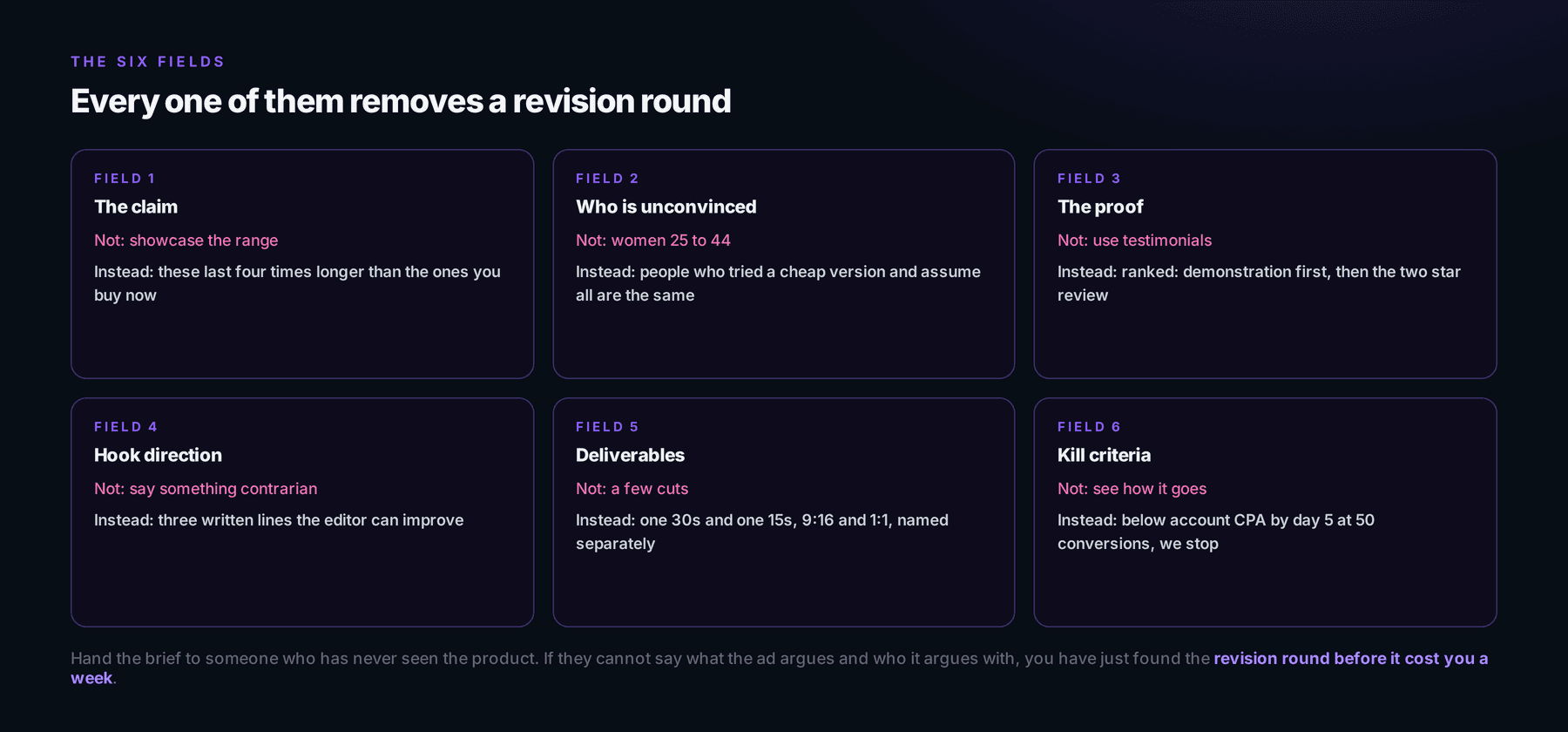
The six fields that matter
1. The claim
One sentence. What must the viewer believe by the end of this ad.
Not "showcase the product range". Not "highlight quality". Something like "these last four times longer than the ones you are buying now". If you cannot write it in one sentence, the concept is not finished and no editor can rescue it.
2. Who is unconvinced
Not a persona. The specific objection this ad is dismantling.
"People who tried a cheaper version and assume all of them are the same." That tells the editor which proof to lead with and which to cut. A demographic block does not.
3. The proof
What evidence carries the claim. Demonstration, testimonial, comparison, number, or credential. Name it explicitly and rank it, because the strongest proof point determines the structure of the edit.
4. The hook direction
Two or three specific openings, written out as lines, not described as formats. "Say something contrarian" is not a brief. "Drinking more water is not why you are tired" is.
Give the editor real lines and they will improve them. Give them a category and they will invent a line you did not want.
5. Deliverables, explicitly
Aspect ratios, lengths, and how many variants. State the short cut as a separate deliverable rather than assuming it. "One 30 second and one 15 second cut, 9:16 and 1:1" is two lines that prevent a week of back and forth.
6. The kill criteria
What result would make you stop running this. Written before launch.
This is the field nobody includes and it is the one that changes behaviour most. Deciding in advance what failure looks like is the difference between a test and a hope. The reasoning is in how long you should run a creative test.
What to leave out
Every field you add costs someone time to fill in and someone else time to read. Cut these.
- Brand guidelines restated. Link them once. Do not paste them into every brief.
- Long reference reels. One reference, with a sentence explaining what specifically to take from it. Five references with no explanation produces an average of five things.
- Full scripts, on iteration briefs. If you are iterating a proven concept, the script already exists. Brief the change, not the whole ad.
- Approval chains inside the document. That is a process problem being solved with paperwork.
Why briefs are usually the bottleneck
When a brand tells us production is slow, the edit is almost never the slow part. Cutting a performance video is a day of work. The two weeks around it are the delay.
Those two weeks are usually: a brief vague enough that the first cut misses, a revision round to correct a misunderstanding that a better brief would have prevented, and an approval queue where three people give notes in sequence rather than together.
A specific brief removes the first two of those entirely. It is the highest leverage document in the whole pipeline and most teams spend eleven minutes on it.
The test for whether a brief is finished
Hand it to someone who has never seen the product. Ask them what the ad is arguing and who it is arguing with.
If they can answer both in one sentence each, the brief works. If they describe the product instead, it does not, and you have just found the revision round before it cost you a week.
One brief per concept, not per batch
Four concepts need four briefs. A single document covering a month of production produces a month of ads that all sound like the same ad, because they were all argued from the same page.
Variants are different. Variants of a proven concept share one brief plus a line each describing what changes. That is the split that makes weekly volume possible without the paperwork becoming the job, and it is the same split described in how many ad creatives you should test each month.