A creative testing system has one job: tell you which ideas deserve budget, fast enough that the answer still matters. Most accounts spending $30k a month or more do not have one. They have a habit of launching new ads and hoping.
Here is the framework we run. It is deliberately boring. Boring is what survives contact with a real account.
The three jobs a testing system has to do
Before structure, be clear on what you are asking the system for. There are only three questions worth spending money to answer.
- Is this idea any good? That is a concept question. It gets answered by testing different claims against each other.
- What is the best version of this idea? That is a variant question. It gets answered by testing hooks, cuts and formats of the same claim.
- Does it still work at scale? That is a durability question. It gets answered in the scaling campaign, not the test.
If your testing setup cannot separate those three, every result is contaminated. A losing concept with a great hook beats a winning concept with a bad one, and you learn the wrong lesson at full price.
Structure: two campaigns, not seven
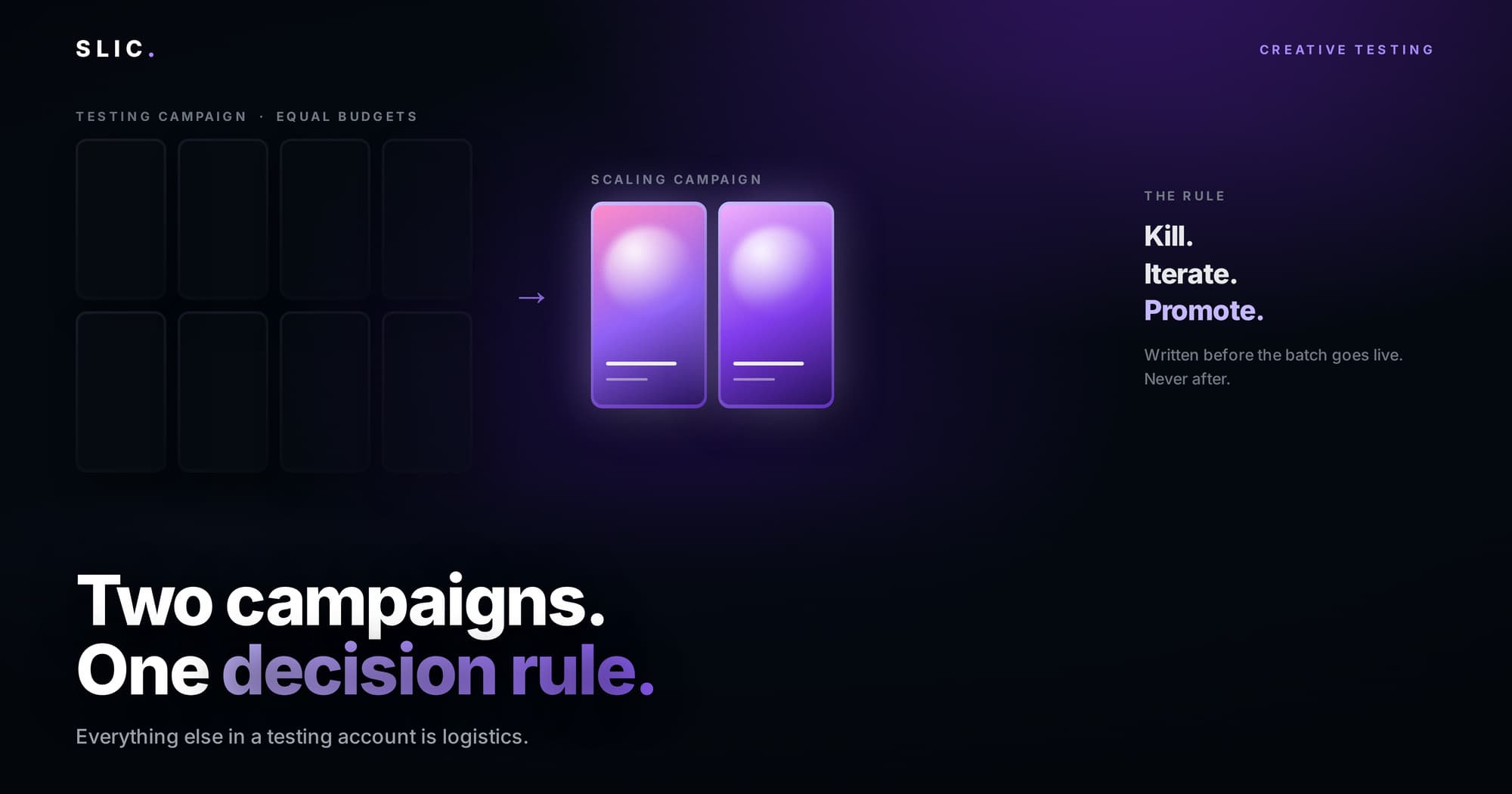
You need a testing campaign and a scaling campaign. That is it.
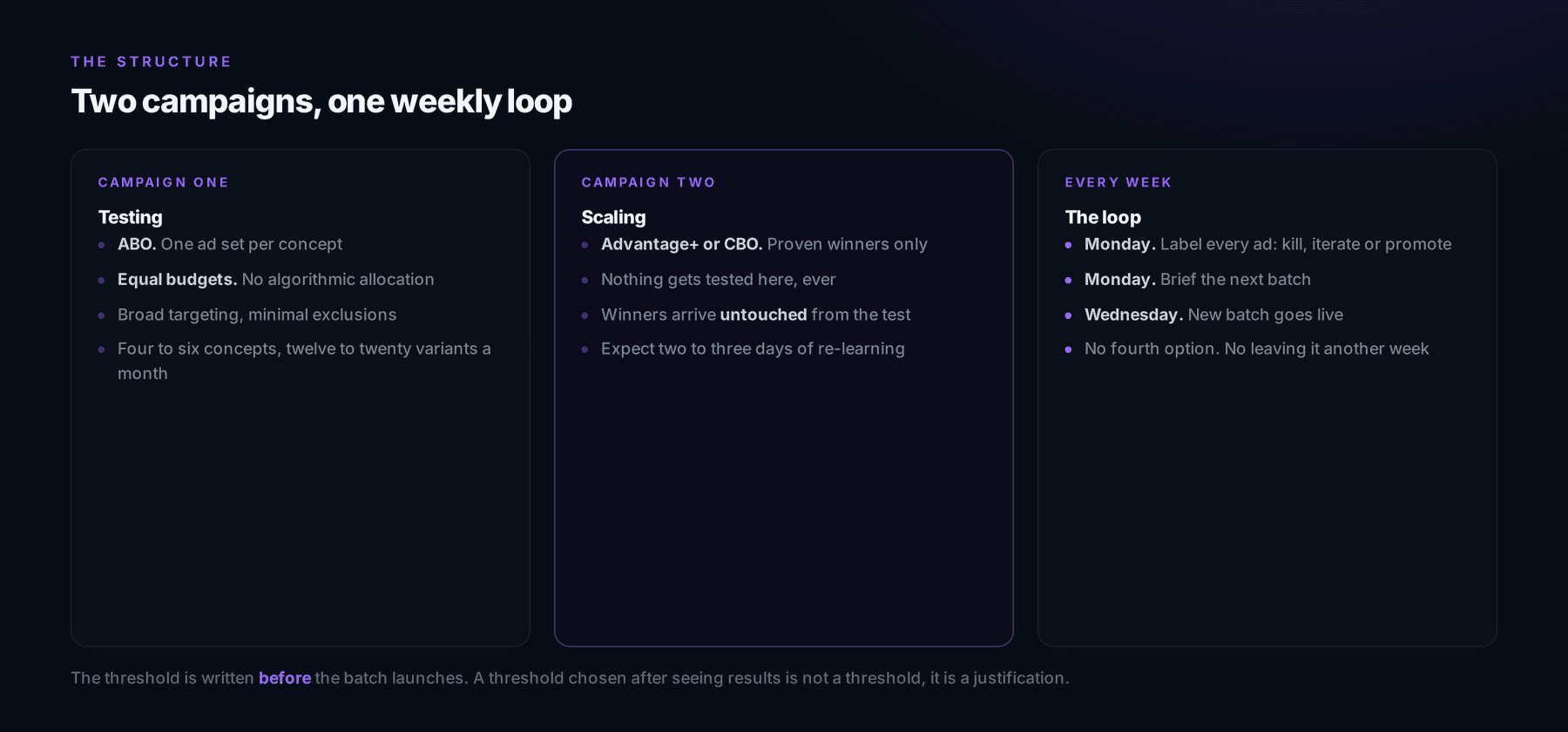
The testing campaign runs ABO, one ad set per concept, equal budgets, broad targeting, no exclusions worth arguing about. Equal budgets matter. The moment you let the algorithm allocate, you are measuring what the algorithm likes on day one, not what your audience likes over a week.
The scaling campaign runs Advantage+ or a CBO with your proven winners and nothing else. Winners get promoted into it. Nothing gets tested here. The moment you drop an untested ad into a scaling campaign to see what happens, you have converted your best performing campaign into an expensive test.
Everything else people add to this, the exclusion layers, the lookalike ladders, the eleven ad sets, is usually there because someone wanted the account to look busy. It costs learning speed and buys almost nothing.
The weekly loop
Cadence beats cleverness. The loop looks the same every week.
- Monday. Read last week. Every ad gets one of three labels: kill, iterate or promote. No fourth option, no "leave it another week to be sure".
- Monday. Brief the next batch. Iterations of anything labelled iterate, plus one or two genuinely new concepts.
- Wednesday to Thursday. New batch goes live in the testing campaign.
- Following Monday. Repeat.
Four to six concepts a month, twelve to twenty variants, is the volume that makes this loop work. We wrote the maths behind those numbers in how many ad creatives you should test each month.
What actually counts as a winner
Pick your threshold before the test, not after. A threshold chosen after you have seen the results is not a threshold, it is a justification.
Reasonable defaults for a DTC account with a functioning funnel:
- Beats account average CPA by 15 percent or more, on at least 50 to 100 conversions depending on your order value
- Hold rate at or above your account average, because a cheap conversion on a weak hold rate rarely survives scale
- Held that position for at least four days, not one good Tuesday
Everything that misses on volume is not a loser. It is undecided, and undecided ads either get more budget or get cut. They do not get to sit there quietly spending.
The decision most teams get wrong is not the winner. It is what happens to everything else. Read the batch as a group and the pattern is usually obvious before any single ad reaches significance.
Promoting a winner without breaking it
A winner in a test at $60 a day is not yet a winner at $600 a day. Move it into the scaling campaign and let it re-learn before you judge it again. Expect performance to dip for two to three days. That dip is not the ad failing, it is delivery finding a wider audience.
What kills more winners than anything else is editing them on the way in. New thumbnail, tighter cut, different CTA, all reasonable ideas, all of which mean the thing you are scaling is not the thing that won. Promote it untouched. Test the improvements as variants afterwards.
Where the framework breaks in practice
Almost never at the strategy layer. It breaks on production speed.
A weekly loop needs a new batch every week. If briefing to live takes your team three weeks, you are not running a weekly loop, you are running a monthly one with weekly meetings about it. The system is only as fast as the slowest step in it, and for most brands that step is approval, not editing.
The four mistakes that cost the most
- Testing variants when you should be testing concepts. Fifteen versions of one idea tells you nothing about whether the idea was right.
- Killing ads on day one. Delivery is unstable for the first 48 hours. A day one read is noise wearing a number.
- Letting winners run untouched for months. Fatigue is real and it arrives faster at higher spend.
- No written record. If last quarter's losing concepts are not documented, you will re-test them. Most teams do, twice a year, and pay full price both times.
Start here
If you are building this from nothing, do it in this order. Split testing and scaling into two campaigns. Set a written winner threshold. Put a weekly decision meeting in the calendar and hold it even when the data is boring. Only then worry about volume.
Volume without a decision rule is just a faster way to spend money. The rule is the system. Everything else is logistics.