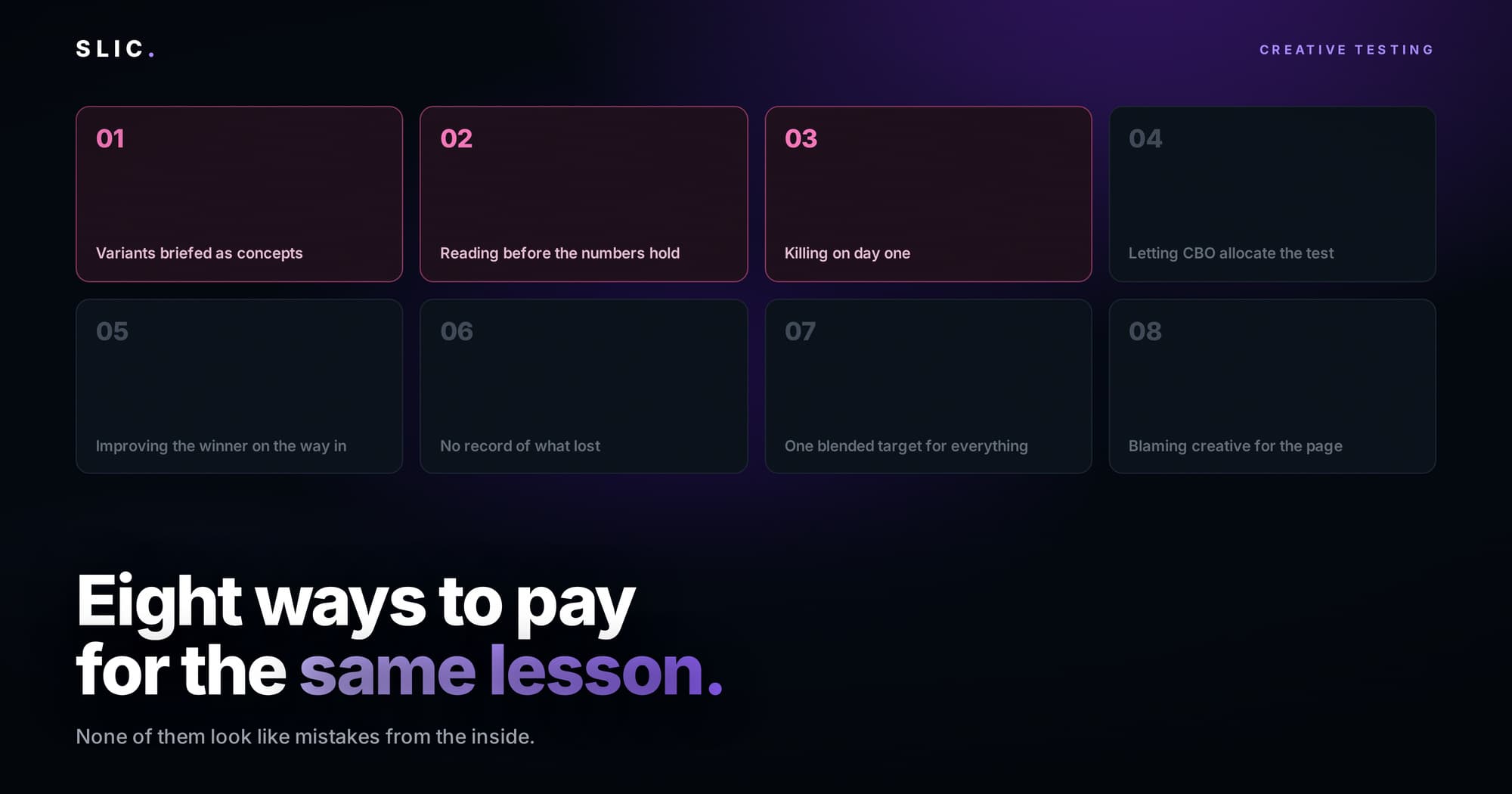
Most creative testing problems aren't creative problems. They're arithmetic problems wearing a creative costume. Here are the eight we see most often, roughly in order of how much they cost.
None of these are exotic. That's the point. The expensive mistakes in a testing programme are usually boring, and they survive for months because nobody's job is to look for them.
1. Testing variants and calling them concepts
You brief six ads. Four of them are the same claim with a different opening. So you've actually tested three ideas, not six, and you're paying for six.
This one is nearly invisible from the inside. The batch looks varied because the footage is different. Count the arguments, not the assets. If two ads would be summarised the same way by a stranger, they're one concept.
2. Reading results before the numbers can carry them
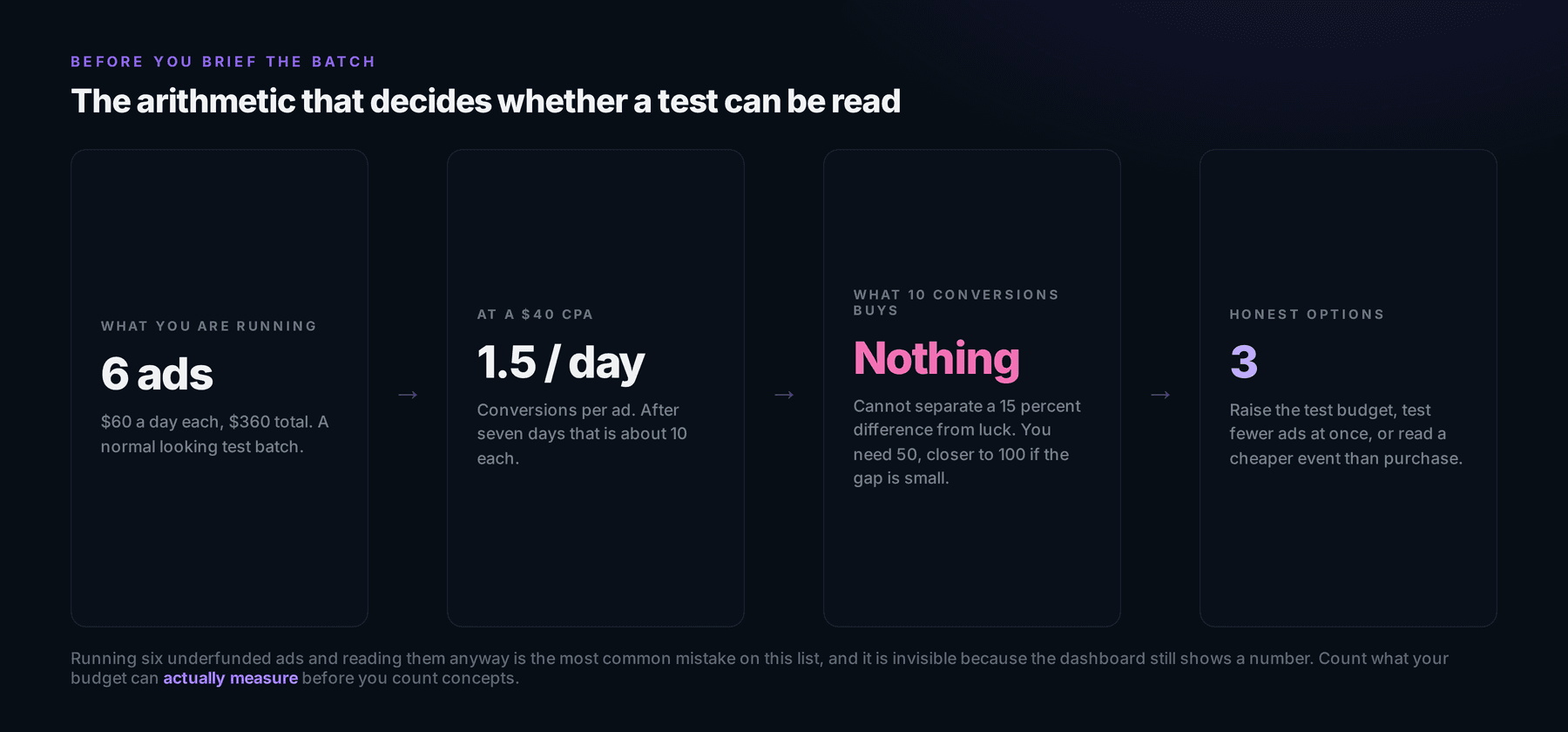
Six ads, $60 a day each, a $40 CPA. That's about one and a half conversions per ad per day. After a week you're looking at ten conversions each and making decisions on them.
Ten conversions can't separate a 15 percent difference from luck. You'd need fifty, closer to a hundred if the gap is small. The full arithmetic is in how long you should run a creative test, but the short version is that most accounts are running more ads than their budget can actually measure.
3. Killing on day one
New ads have no delivery history, so the first 48 hours are the auction working out who to show them to. Two ads from the same batch will sit 40 percent apart on CPA at the 24 hour mark and then converge by day four.
Kill on day one and you're not killing bad creative, you're killing whichever ad got the worse start. We've done this ourselves and only noticed when a concept we'd binned in March won in July after somebody re-tested it by accident.
4. Letting the algorithm allocate during a test
If you run your test as a CBO, the system moves budget toward whatever looks good on day one. That's exactly what you want in a scaling campaign and exactly what ruins a test, because you end up measuring early delivery luck rather than which idea holds up over a week.
Test on ABO with equal budgets. Scale on CBO or Advantage+. Two campaigns, different jobs.
5. Improving the winner on the way into scaling
An ad wins, and before it goes into the scaling campaign somebody tightens the cut, swaps the thumbnail and updates the CTA. All three are reasonable ideas.
Now the thing you're scaling isn't the thing that won, and when it underperforms you've no idea which change did it. Promote it untouched. Run the improvements as variants next month and let the data decide.
6. No written record of what lost
Ask most teams what failed last quarter and you'll get a shrug. Which means the same dead angle gets briefed again in about six months, at full price, by somebody who wasn't there the first time.
A one line note per concept is enough. What it claimed, what it cost, what happened. Ten minutes a month and it's the cheapest thing on this list.
7. Judging every ad against one blended target
A single ROAS target applied across prospecting and retargeting quietly strips out everything that acquires new customers, because top of funnel creative was never going to return the same number on first purchase.
What's left is an account that harvests existing demand very efficiently. ROAS looks great and revenue is flat. If that's your last two quarters, the measurement is doing it, not the creative. More on which metric belongs where in ROAS, CPA or MER.
8. Blaming creative for something that happened after the click
Strong CTR and weak add to cart isn't a creative failure. The ad did its job and delivered a qualified person to the page. Something after the click broke, usually congruence between what the ad promised and what the page leads with, sometimes a price the viewer sees for the first time on landing.
Briefing three new videos to fix that is expensive and it's the response most teams reach for. Check the page first. It's free.
What to actually do about it
You don't need to fix all eight. Two changes catch most of the damage.
First, before each batch goes live, write down the threshold that counts as a win and the read window you'll use. A rule set in advance is a system. A rule set after seeing the results is a story you're telling yourself about the ad you liked.
Second, count the arguments in your batch rather than the assets. If the honest number is three rather than six, you've just found where half your testing budget is going.
The structure underneath all of this, and the weekly loop that keeps it running, is in the Meta creative testing framework.