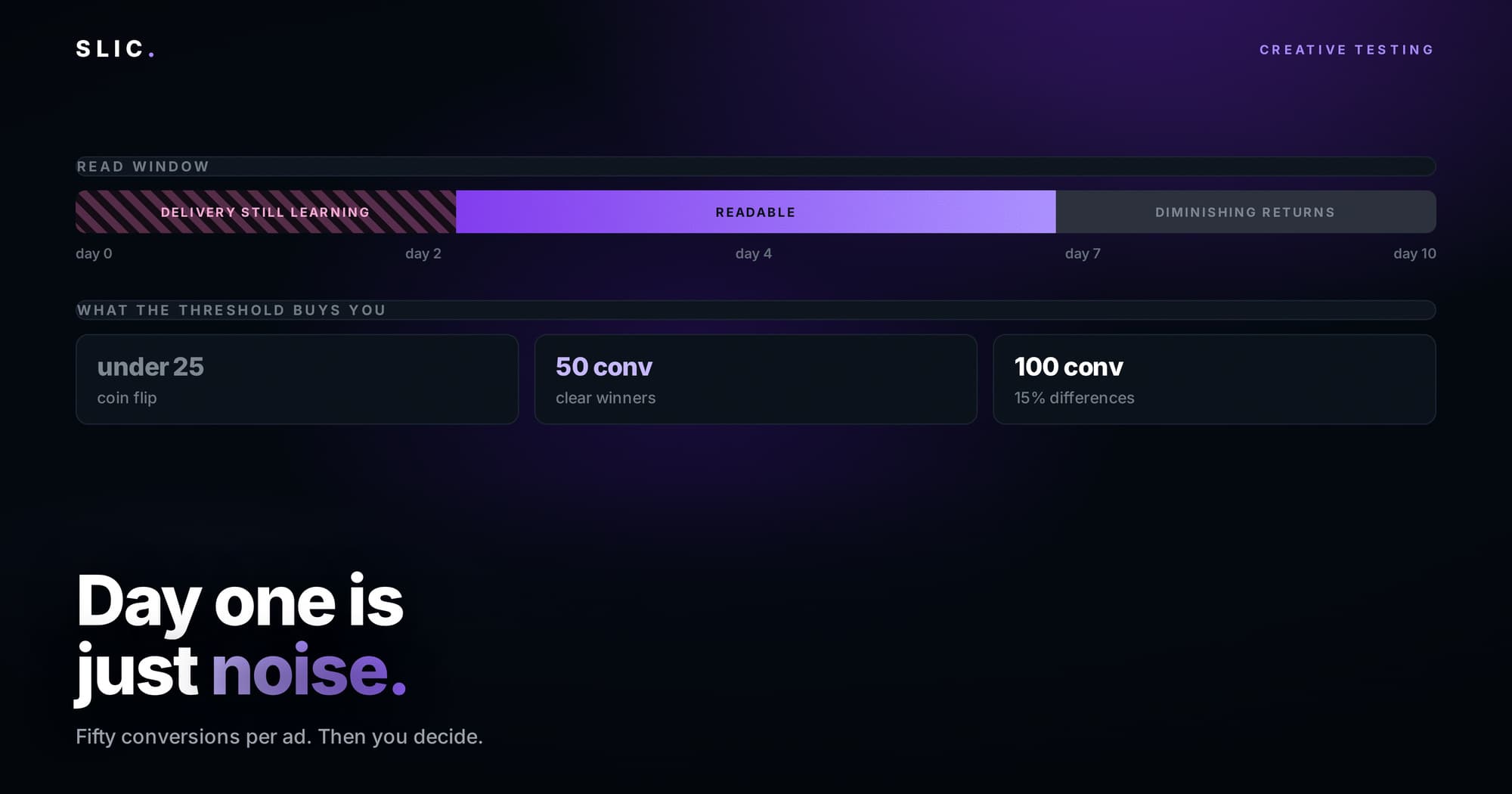
Give a creative test three to seven days and a minimum of 50 conversions per ad before you call it. Anything shorter is measuring delivery noise. Anything longer is usually you avoiding a decision you already know the answer to.
That is the short version. The reason it is a range and not a number is that time is the wrong unit. Conversions are the unit. Days are just how long it takes to get them.
Why day one and day two are worthless
When a new ad enters delivery, the auction has no history for it. Meta spends the first period working out who to show it to, and during that window your cost per result swings for reasons that have nothing to do with the creative.
Two ads from the same batch, same concept, same offer, will routinely sit 40 percent apart on CPA at the 24 hour mark and then converge by day four. If you kill on day one you are not killing bad creative. You are killing whichever ad happened to get the worse start.
The practical rule is simple. No decisions in the first 48 hours. None. Not even good ones, because promoting a false winner costs the same as killing a real one.
The number that actually decides it
Set your read threshold in conversions, then work out how many days that takes at your budget.
- 50 conversions per ad is enough to separate an obvious winner from an obvious loser.
- 100 conversions per ad is enough to trust a difference of 15 to 20 percent.
- Under 25 conversions you are reading a coin flip with a nice interface on top.
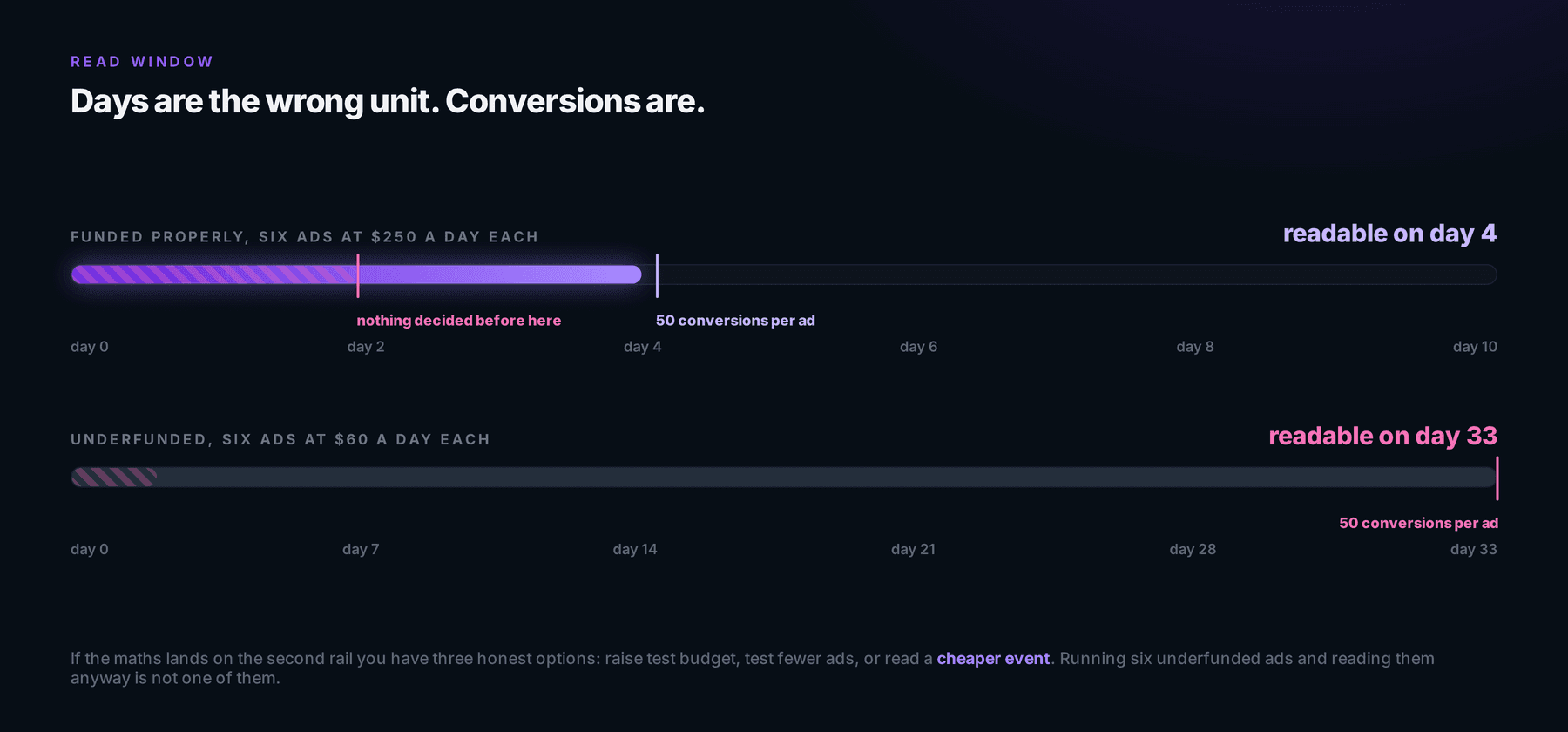
Now do the arithmetic in reverse. If your CPA is $40 and you are running six ads at $60 a day each, each ad produces roughly 1.5 conversions a day. Fifty conversions is a month. That is not a testing plan, that is a hostage situation.
When the maths comes out like that you have three honest options, and only three.
- Raise test budget so each ad clears the threshold in a week.
- Test fewer ads at once so the same budget concentrates.
- Read a cheaper event. Judge on add to cart or landing page view instead of purchase, accepting the correlation is imperfect.
What you cannot do is keep six underfunded ads running and pretend the numbers mean something. That is the most common failure in creative testing and it is invisible because the dashboard still shows a number.
Read the batch before you read the ad
Single ads reach significance slowly. Batches reach it fast.
If four variants of one concept are all underperforming at day three, the concept is dead. You do not need any individual ad to be statistically conclusive, because the pattern across four of them already is. That is the fastest read available to you and almost nobody uses it.
The reverse holds too. One winner among four variants of the same idea usually means the hook won, not the idea. Test that hook against a different concept before you build a month of production on it.
When to stop early
Two situations justify killing before the threshold.
The hook is dead on arrival. If hold rate is far below your account average, the ad is not being watched and no amount of extra spend changes that. This is visible in hours, not days, because view metrics accumulate much faster than conversions. The full logic is in why your hook dies at three seconds.
Spend with zero conversions. If an ad has spent three times your target CPA with nothing, stop it. It is not statistically conclusive but it is commercially conclusive, which is the one that pays for things.
When to run longer
Extend past seven days when the ad is close to threshold and trending in the right direction, when your purchase cycle is genuinely long, or when you are testing a fundamentally new positioning rather than a new execution. New positioning deserves patience because a weak first result may be an audience learning problem rather than a message problem.
Do not extend because you like the ad. Everyone does this. It is the single most expensive emotion in a media account.
The rule worth writing down
Decide the read window and the threshold before the ads go live, put both in the brief, and hold to them. A rule set in advance is a system. A rule set after seeing the data is a story you are telling yourself about why the ad you liked deserves another week.