
Put 15 to 25 percent of paid social spend into creative testing. Below 10 percent you cannot generate enough winners to replace the ones that fatigue. Above 30 percent you are funding experiments with money that should be buying revenue from things you already proved work.
Most brands sit somewhere near 5 percent, discover it by accident, and then wonder why performance decays every quarter.
Why the number is a percentage and not a fixed amount
Creative fatigue scales with spend. The more you spend, the faster your audience sees the same ad, and the faster it stops working. A brand at $20k a month might get three months out of a winner. The same brand at $150k a month might get five weeks.
So the replacement rate has to scale too. Testing budget is not a marketing luxury you fund when things are going well. It is the cost of keeping the scaling campaign supplied. Cut it and the decline is invisible for about six weeks, then arrives all at once.
Working out your own number
Do this in three steps rather than copying a benchmark.
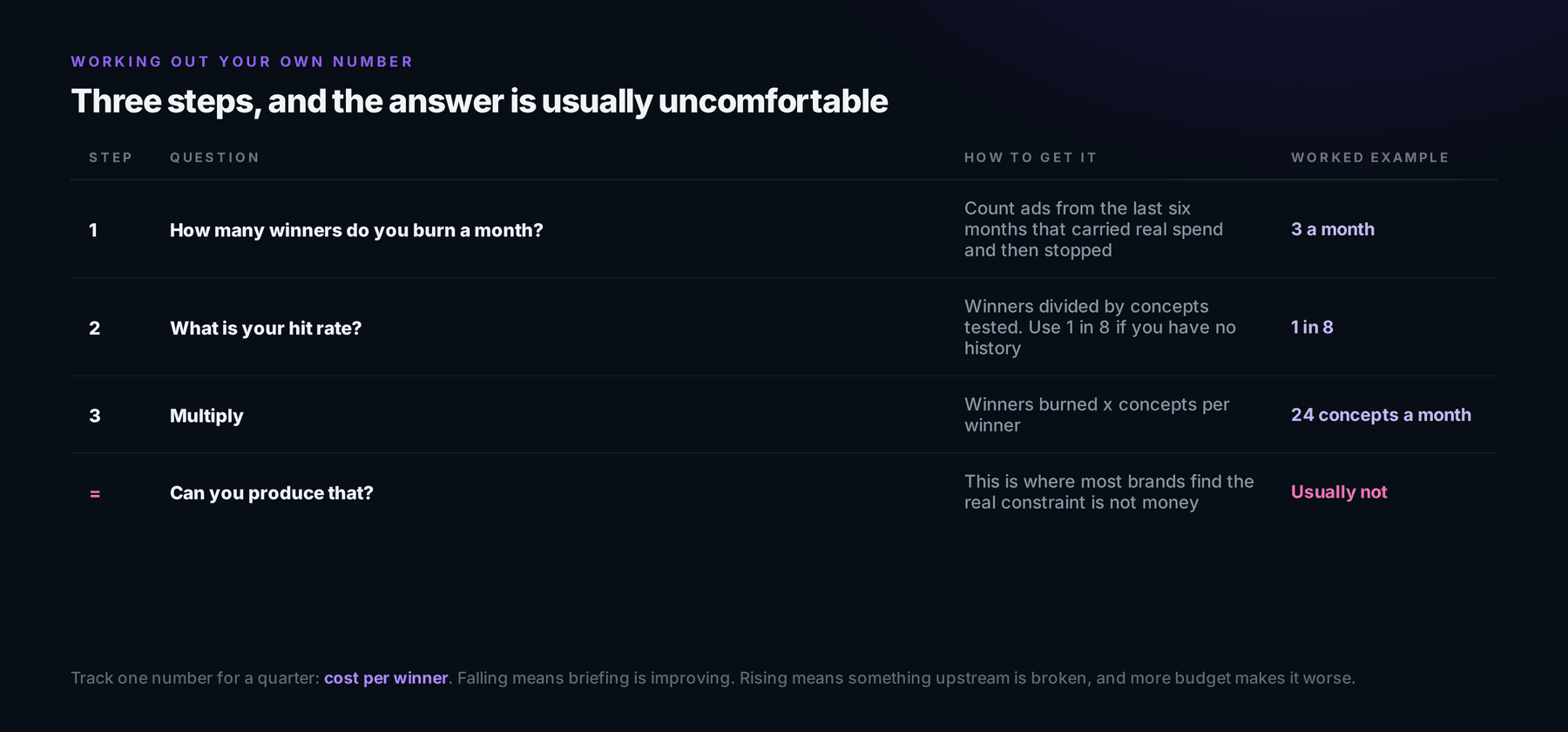
Step one. How many winners do you burn a month? Look at the last six months. Count how many ads carried real spend and then stopped performing. For most DTC accounts at scale it is two to four a month.
Step two. What is your hit rate? Across DTC accounts, somewhere between one in five and one in ten concepts becomes a genuine winner. Use your own number if you have six months of history. Use one in eight if you do not.
Step three. Multiply. If you burn three winners a month and one in eight concepts wins, you need to test twenty four concepts a month to stay level. That is almost certainly more than you are doing, which is the actual finding here.
Now price it. Twenty four concepts needs enough budget for each to reach a readable threshold. At 50 conversions per ad and a $40 CPA, that is $2,000 of spend per concept to get a clean read, and the number gets uncomfortable quickly.
This is the point where most brands discover their real constraint is not budget at all. It is that they cannot produce twenty four concepts a month, so the money would have nowhere to go.
The two ways to make the number affordable
Read a cheaper event. You do not need purchase level confidence to kill a concept. Hold rate, click through rate and cost per add to cart all accumulate far faster and are enough to eliminate the bottom half of a batch. Reserve purchase level reads for the finalists. This alone can halve testing cost.
Kill in batches, not one at a time. Four variants of one concept underperforming together is a decision you can make on day three. Waiting for each individual ad to reach significance triples what the test costs and rarely changes the answer.
What testing budget is not for
Three things get charged to testing that should not be.
- Re-launching last quarter's winner. That is scaling budget. You already know the answer.
- Audience and placement experiments. Real work, different budget line. Mixing them means you never know whether the creative or the targeting moved.
- Seasonal and promotional creative. If it has to run regardless of test results, it is a production cost, not a test.
Keeping these separate matters because it is the only way to know whether your testing budget is earning anything. If everything unusual gets charged to testing, the line item always looks expensive and always gets cut first.
How to tell if the spend is working
One metric. Winners produced per month, divided by testing spend. Track it for a quarter.
If cost per winner is falling, your briefing is getting better and you should consider spending more. If it is flat, your process is stable and the budget is correct. If it is rising, more money will not fix it. Something upstream is broken, usually the brief, sometimes the offer.
That last case is worth sitting with. Rising cost per winner while volume stays constant almost always means the creative team has run out of genuinely new angles and is producing variations dressed as concepts. More budget makes that worse, not better.
The floor
If you take one number from this, take the floor. Below 10 percent of spend on testing, you are not maintaining a creative pipeline. You are drawing down on winners you already have and the bill arrives later, all at once, usually in a quarter where you needed the numbers to hold.
If you want to see how a supplied pipeline actually runs, our case studies show the volume and cadence behind the accounts we scale.