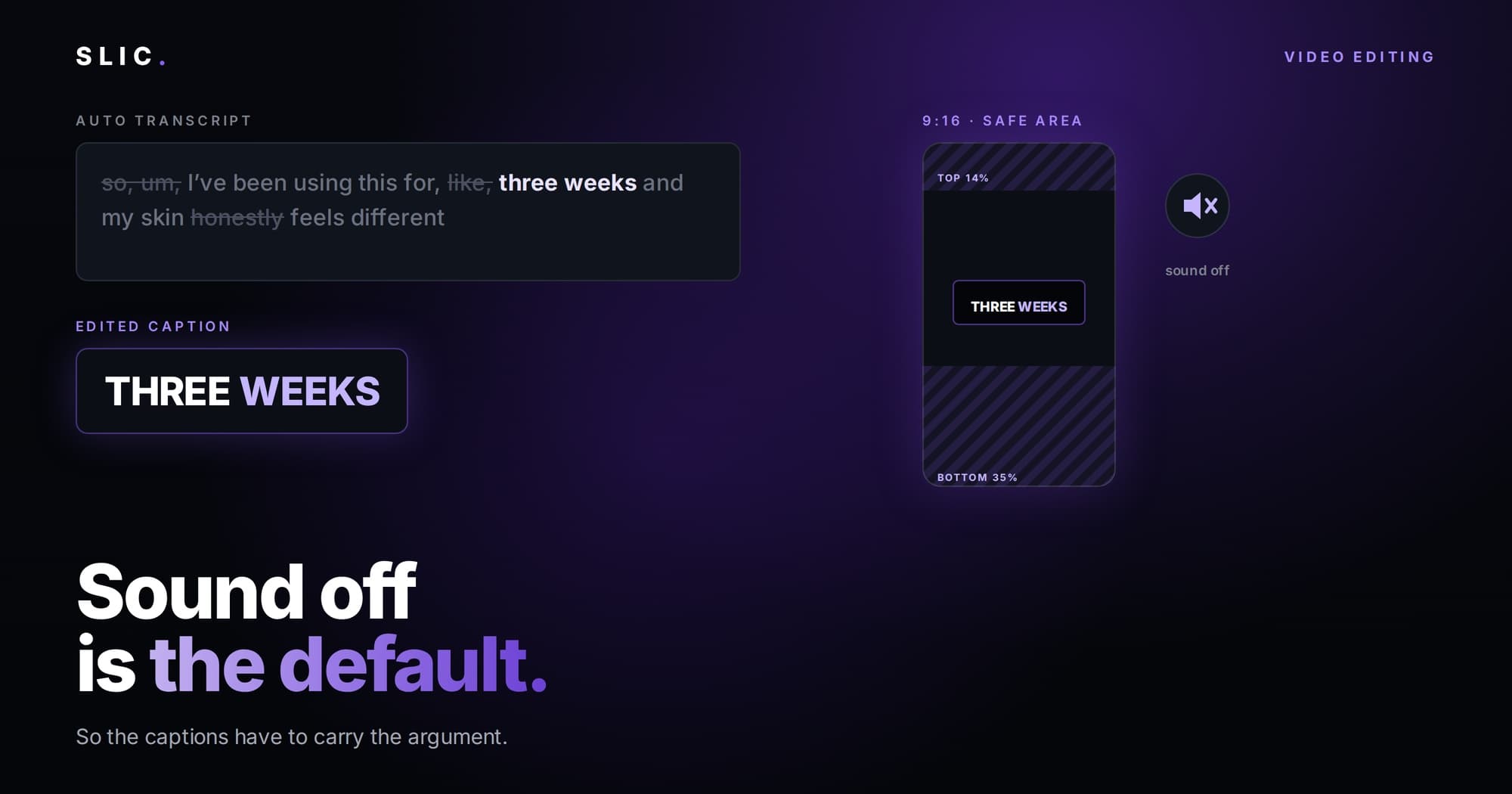
If someone can't follow your ad with the sound off, a good share of your audience never hears the pitch. Plenty of people scroll with their phone muted, on the train, in bed or at their desk. For them the captions are the ad.
Most brands treat captions as a finishing step, something the editor adds at the end with an auto caption tool. That's where a lot of otherwise good ads lose people.
A transcript and a caption do different jobs
Auto captions transcribe. They put every word on screen, filler included, in whatever chunks the tool decides. "So, um, I've been using this for, like, three weeks" becomes a line of text nobody reads.
A working caption gets edited like the footage. It keeps the words that carry the argument and drops the rest. It breaks lines where a person would naturally pause. And it picks out the one word in each line that matters, whether that's the number, the result or the product name, and makes it stand out.
The caption doesn't have to match the audio word for word. It has to carry the same meaning in fewer words, fast enough to read at the pace the person is speaking.
How many words fit on screen
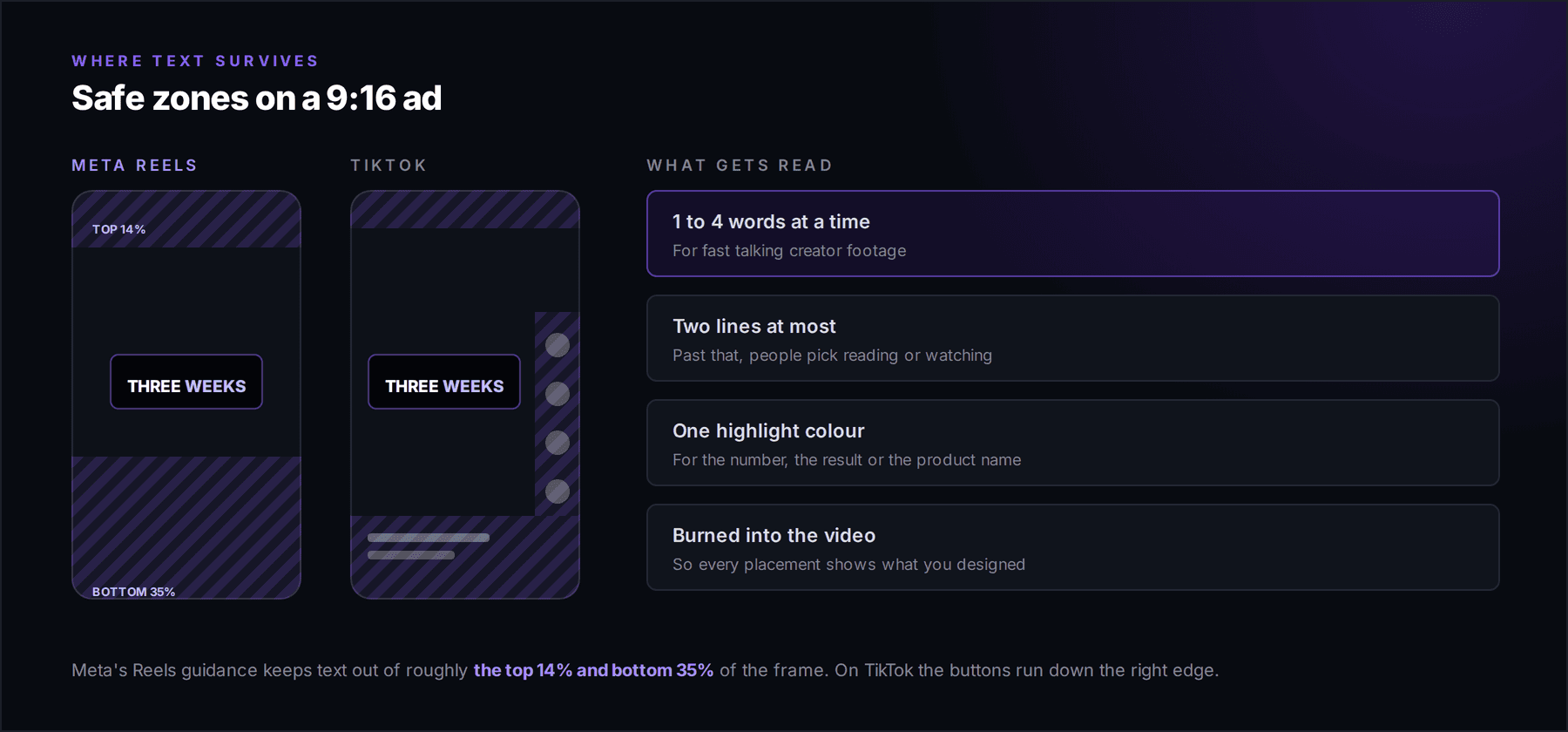
For fast talking creator content, one to four words at a time works best. The viewer takes in a short chunk almost without trying, and the rhythm matches the speech.
For slower voiceover or explainer ads, one or two short lines at a time is fine. Past two lines, people start choosing between reading and watching, and they usually end up doing neither.
Where to put them
Every platform covers part of a vertical video with its own interface. Meta's guidance for Reels is to keep text and logos out of roughly the top 14 percent and the bottom 35 percent of a 9:16 frame, with a small margin down each side. On TikTok the buttons run down the right edge, and the caption and account name sit along the bottom.
In practice that leaves the middle of the frame, slightly above centre. Captions placed down at the bottom, where they'd sit on a TV, get covered by the platform.
Styling that gets read
High contrast first. White text with a dark outline or a solid box behind it survives any background. Pick one font and one size, and keep them consistent across the whole ad.
Use one highlight colour for the words that matter. If everything's highlighted, nothing is. And keep the text large enough to read on a phone held at arm's length, which is bigger than it looks on an editing monitor.
The mistakes we fix most often
Captions that lag behind the speech. If a word appears after it's been said, the viewer is always reading the past. Captions should land with the word or a fraction before it.
Captions sitting over the product. The thing you're selling shouldn't be hidden behind a text box, so move the text or move the crop.
Long lines in capitals. All caps works for two or three words and gets hard to read beyond that.
Low contrast on busy footage. White text on a bright kitchen counter disappears. Add the outline or the box.
Effects on every line. A caption that bounces, spins and changes colour on every word pulls attention away from the claim it's meant to carry.
The hook text has a separate job
The line at the top of the frame in the first three seconds works more like a headline than a caption. It states the promise or the problem in a few words, and it has to land even if the viewer never hears the audio.
It can say something the creator hasn't said yet, and often it should, because the creator's first line is doing a different job. There's more on getting that opening right in why your hook dies at three seconds.
Burn them in
Platforms offer their own automatic captions, but you can't control how they look, where they sit or what they get wrong. For ads, burn the captions into the video so every placement shows exactly what you designed.
Then run the test that matters most. Watch the ad on your phone, muted, at arm's length. If you can repeat the pitch back afterwards, the captions work. If you can't, check the retention graph as well, because a hold rate problem is often a caption problem underneath. What healthy numbers look like is in hook rate and hold rate benchmarks.