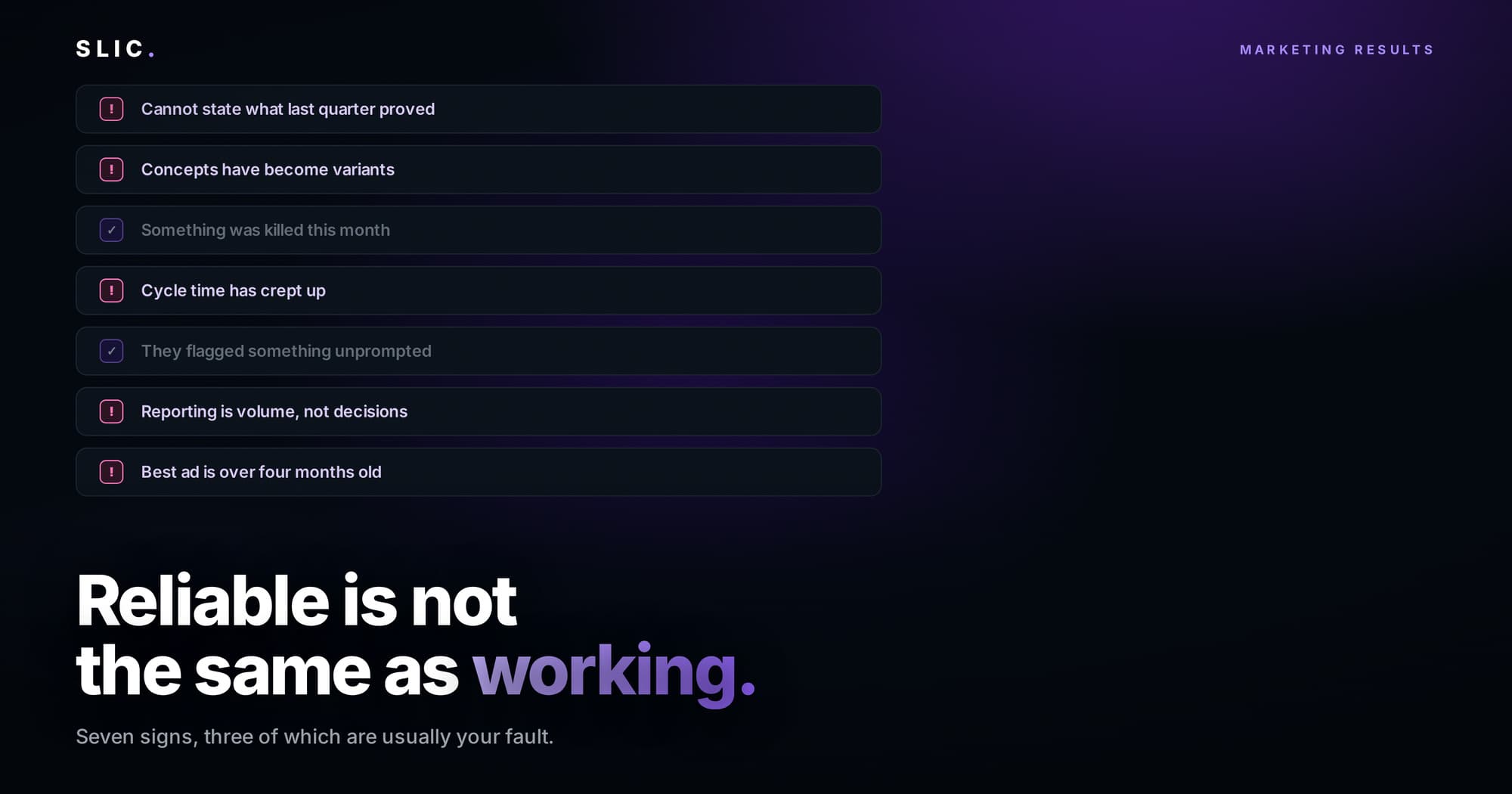
The clearest sign an agency has stopped trying is that their output has stopped changing. Same structures, same openings, same three ideas in rotation, delivered on time every month. Reliability without learning looks like a healthy relationship right up until you check the numbers year on year.
We run an agency, so read this with that in mind. It is also the honest list, because these are the failures we watch for in our own work.
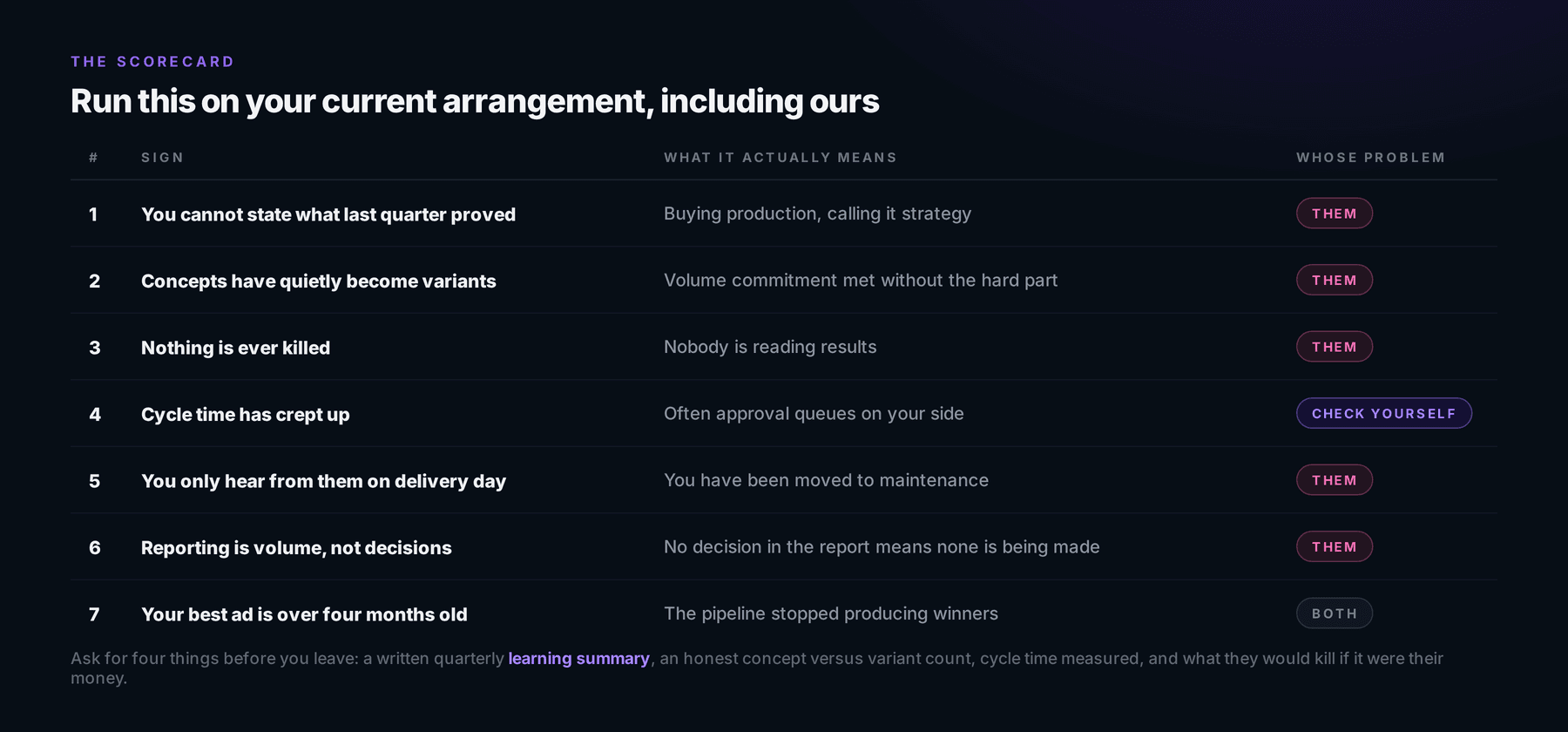
1. You cannot state what last quarter proved
Ask what the last three months of testing established about your customer. A working relationship produces specifics: which angles beat which, what the audience turned out not to care about, what changed as a result.
If the answer is a summary of what got delivered rather than what got learned, you are buying production and calling it strategy. That is fine if it is what you agreed to. It is expensive if you thought you were buying judgement.
2. Concepts have quietly become variants
Look at last month's batch. Count the genuinely distinct arguments. Most brands find two or three where they were told there were six.
Variants dressed as concepts is the easiest way to hit a volume commitment without doing the hard part, and it is nearly invisible unless you go looking. The distinction and why it matters is in how many ad creatives you should test each month.
3. Nothing is ever killed
A partner who never recommends stopping something is not reading results. Killing your own work is uncomfortable and it is the clearest evidence anyone is actually paying attention.
Watch specifically for whether they will kill a concept you liked. Agencies that only ever kill their own ideas and never yours have made a decision about the relationship that has nothing to do with performance.
4. Cycle time has crept up
Time your last five requests from brief to live. Compare it to six months ago.
Creep is almost universal and almost always unremarked. It happens because your account got busier, or your contact changed, or you became reliable enough to deprioritise. If a finding now takes three weeks to become an ad and your creative fatigues in four, you are structurally behind whatever you are paying.
5. You only hear from them when something is due
Proactive contact is the cheapest signal of engagement there is. Someone who noticed something in your account and flagged it unprompted is thinking about you between deliverables.
An agency that appears on delivery day and disappears until the next one has moved you to maintenance. That happens to every account eventually unless somebody actively resists it.
6. Reporting is volume, not learning
A report that lists assets delivered, impressions and a ROAS figure tells you what happened. It does not tell you what anyone concluded or what changes next month as a result.
The test is whether the report contains a decision. Not a number, a decision. If it does not, nobody is making them, or nobody is making them where you can see.
7. Your best performing ad is more than four months old
The single most damning one, because it is a fact rather than a judgement.
If nothing produced this quarter has beaten something produced last year, the pipeline has stopped generating winners. It may still be generating output. Those are not the same thing and only one of them is what you are paying for.
Before you fire anyone
Three of these are frequently the client's fault and it is worth checking honestly.
- Slow cycle time is often approval queues on your side, not production on theirs.
- Repetitive concepts happen when the agency has no access to reviews, support tickets or sales calls. New angles come from customer language, and if you never supplied any, there was nowhere for them to come from.
- Weak learning happens when testing budget is too thin to produce readable results. Nobody can learn from six underfunded ads. That maths is in how much of your budget should go to creative testing.
Fix those three, give it a quarter, and re-run the list. If the same signs are still there with the constraints removed, the problem is not structural.
What to ask for instead of leaving
Most of this is recoverable if you name it directly. Ask for a written quarterly learning summary. Ask for the concept count, split honestly between new arguments and variants. Ask for cycle time measured and reported. Ask what they would kill if it were their money.
Every one of those is reasonable and none of them costs anything to provide. An agency that resists all four has told you the answer.
If you want an outside read on what your current creative is doing and where it is losing people, book a call and we will go through your account with you.