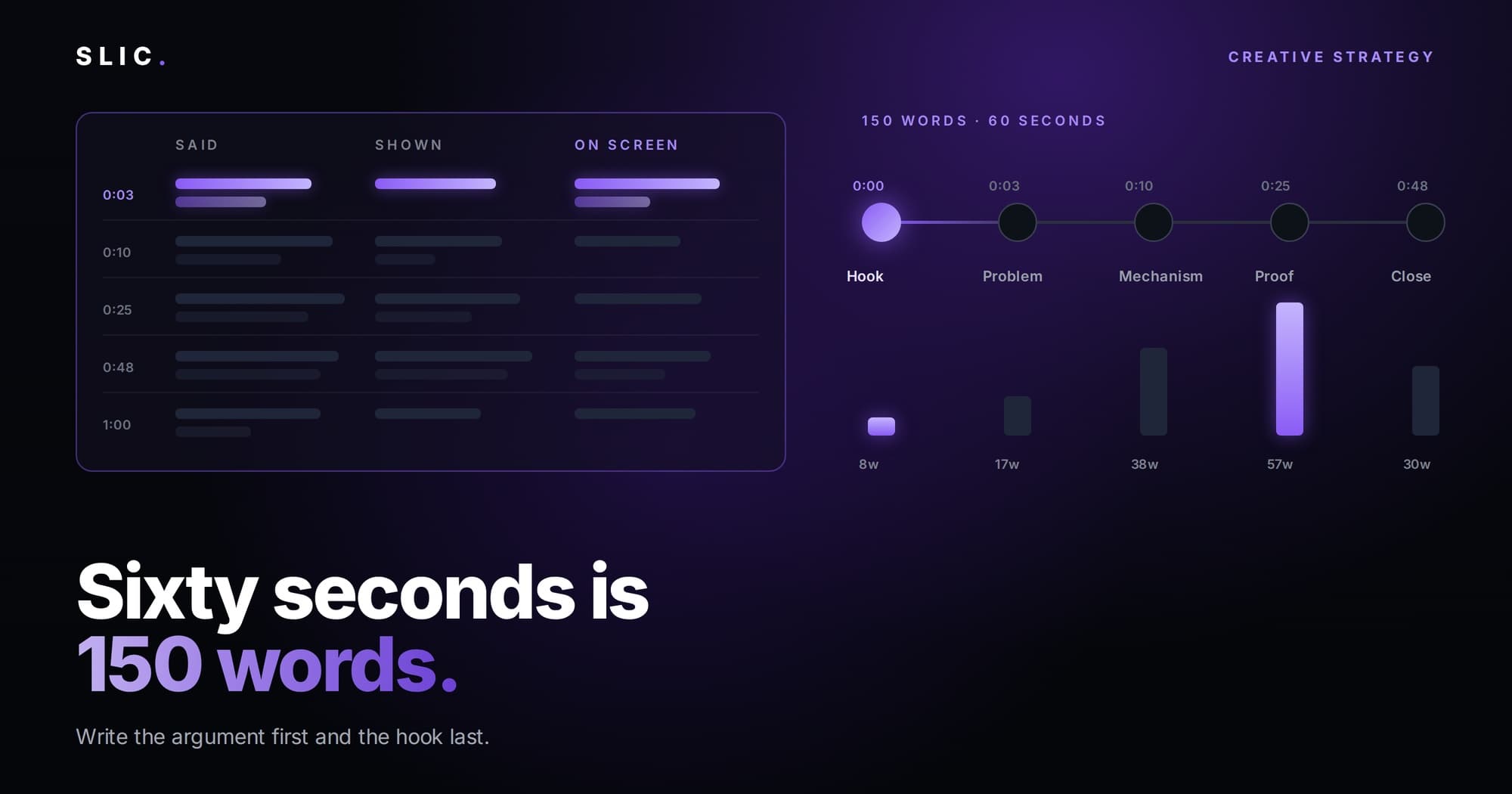
A 60 second video ad holds about 150 spoken words. This paragraph has fewer than 50. Most first drafts run to twice the limit, which is why so many ads feel rushed on camera or get cut down in the edit until the argument stops hanging together.
The fix starts before anyone writes a line of dialogue.
Decide what the ad proves before you write it
Every script should be able to finish the sentence "after watching this, the viewer believes" with one claim. Maybe it's that the product lasts four times longer, or that it sets up in under a minute, or that it works out cheaper across a year than whatever they're using now.
If you can't finish the sentence, you're about to write an ad about the brand in general, and those rarely convert. If you can finish it three different ways, you've got three separate ads, and each one deserves its own script. Keeping a brief down to a single argument is covered in the creative brief that makes performance video faster.
The five parts of a one minute script
Nearly every direct response ad we script follows the same shape. The timings move around, but the jobs stay the same.
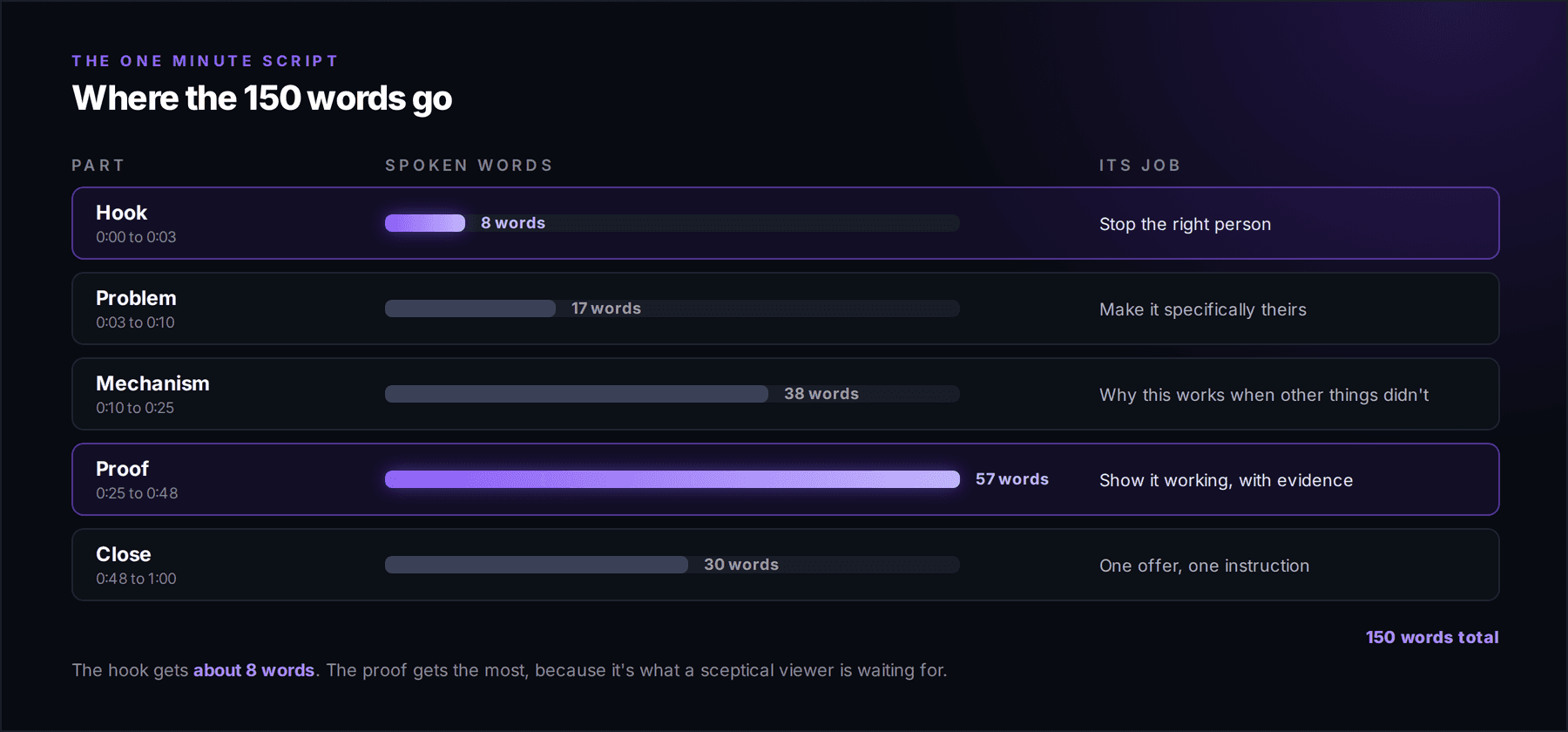
The hook, roughly the first three seconds. Seven or eight words that make the right person stop. It names a problem, a result or a surprise, and it's written on screen as well as spoken.
The problem, up to about ten seconds. Make it specifically theirs. "Your phone's the first thing you touch every morning" does far more work than "screen time is a big issue".
The mechanism, through to around 25 seconds. Why this product solves it when other things haven't. This is the part that separates your ad from an ad for the whole category.
The proof, most of the second half. Demonstration, results, reviews, numbers, comparisons. It gets the most time because it's what a sceptical viewer is waiting for.
The close, the last ten to fifteen seconds. The offer and one clear instruction.
A one minute script, compressed
Here's the shape for a made up product, a carry on backpack, with one line per part.
Hook: "This bag replaced my suitcase for a two week trip." On screen it reads Two weeks. One bag.
Problem: "Checked luggage costs you money on the way out and an hour at the carousel on the way back."
Mechanism: "It opens flat like a suitcase and still fits the cabin limit on most airlines, so you pack it like one and carry it like a backpack."
Proof: Packing it in real time, the bag sliding into an overhead bin, the sizer at the gate and three reviews on screen.
Close: "It's 20 percent off this week. Tap the link to see the sizes."
Every line does one job. Nothing introduces the brand, and the name only needs to appear on screen during the close.
Write the hook last
It feels backwards, but the hook is much easier to write once you know exactly what the rest of the ad says. Write the body first, then write eight or ten openings for it, then pick three to film.
Filming several hooks for the same body is the cheapest creative test there is. The body stays constant, so when one version outperforms, you know the opening did it. The openings worth trying are in nine hook formats that still work on Meta.
Write for the viewer with the sound off
A script that only works as audio is half a script. We write in three columns: what's said, what's shown and what's written on screen. If a line has nothing in the shown column, it's usually a line the viewer will scroll past.
The on-screen text shouldn't simply repeat the voiceover. It should carry the argument in fewer words, so someone watching muted still gets the claim, the proof and the offer.
Lines we cut from almost every first draft
"Have you ever wondered" openings. The viewer hasn't, and now they've gone.
Introducing the brand before the problem. Nobody cares who you are until they care about what you fix.
Features without consequences. "Made with medical grade silicone" means nothing until you say what it changes for the person using it.
Stacked calls to action. Shop now, follow us, use the code, check the link. Pick one.
Superlatives nobody can check. "The best" and "revolutionary" read as ad copy, and people skip ad copy.
Read it out loud with a timer
Before anything gets filmed, read the script out loud at a normal pace. If it runs past 60 seconds, cut words. Don't plan on speeding up the delivery, because rushed talent reads as nervous and the edit can't fix that.
Then read it a second time looking only at the shown and on-screen columns. If the ad still makes sense without the audio, it's ready to shoot. If length is the thing you're unsure about, how long should a video ad be goes through when shorter wins and when it doesn't.