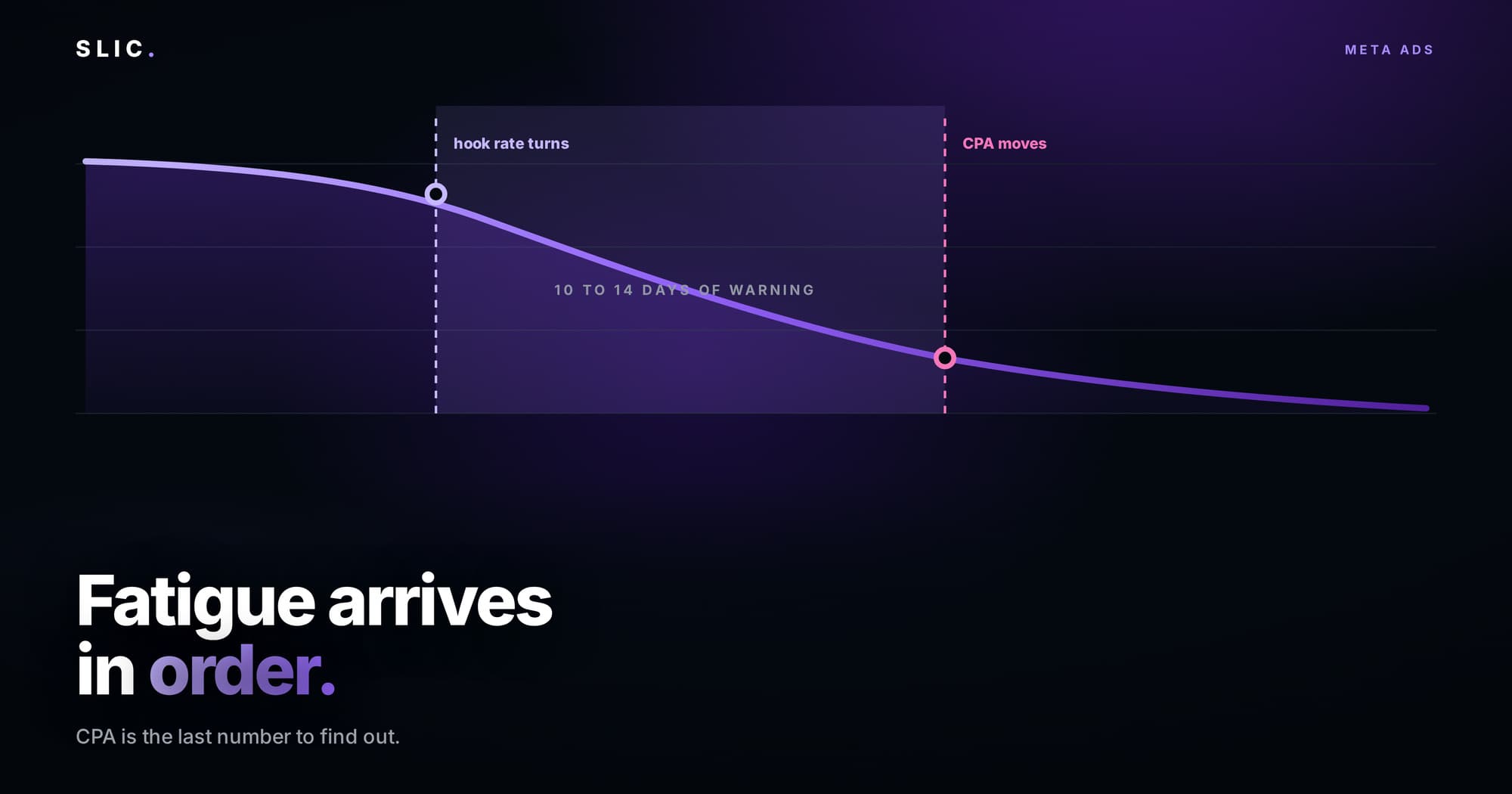
Creative fatigue shows up in frequency and hold rate one to two weeks before it shows up in CPA. By the time your cost per acquisition moves, you have already spent a fortnight paying more than you needed to.
Fatigue is not a mystery and it is not sudden. It has a specific signature that appears in order, and if you know the order you can act on the first signal instead of the last one.
The order fatigue arrives in
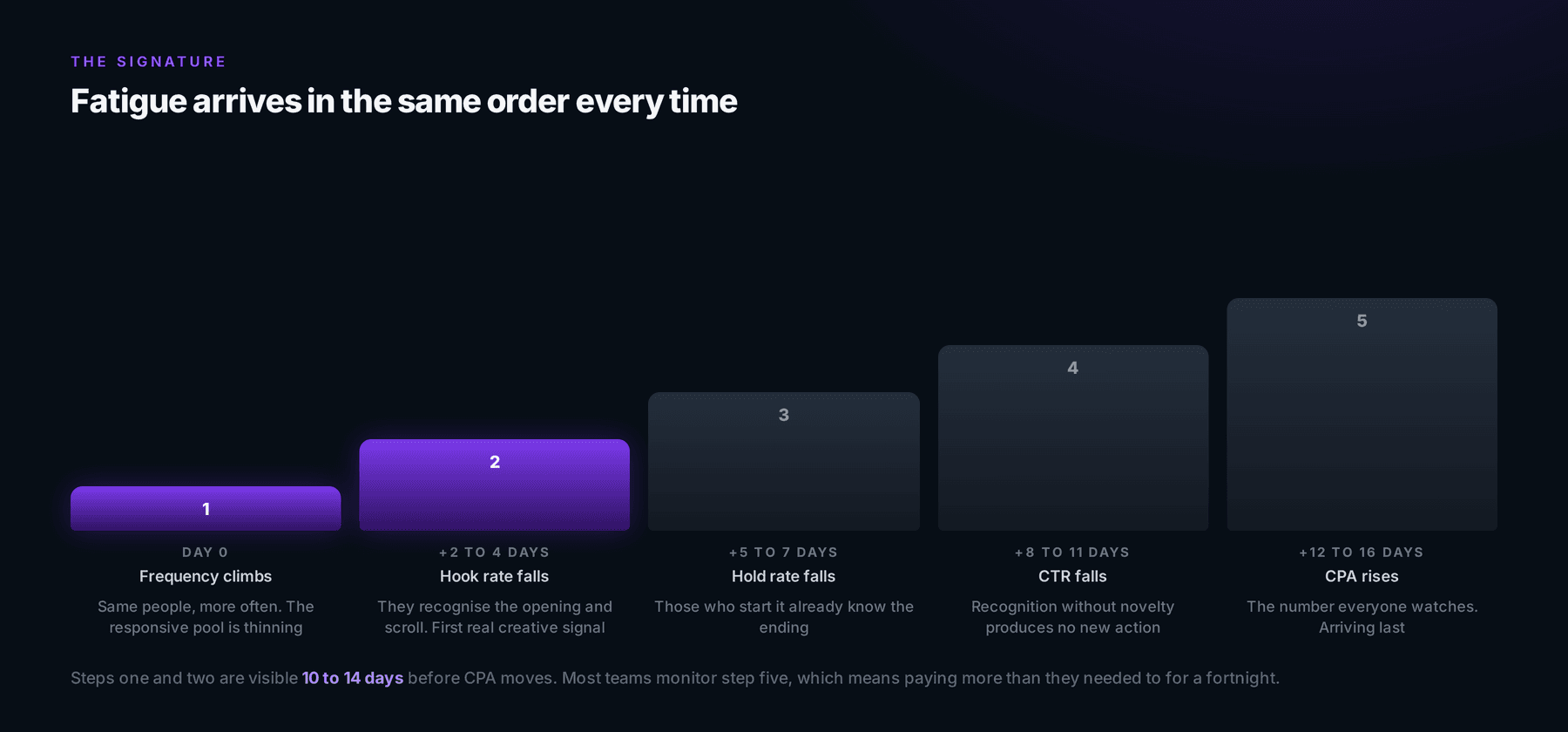
Every fatiguing ad goes through roughly the same sequence.
- Frequency climbs. The same people are seeing it more often because the algorithm has exhausted the responsive pool.
- Hook rate falls. People recognise the opening frame and scroll before it plays. This is the first real creative signal.
- Hold rate falls. Those who do start it already know the ending.
- CTR falls. Recognition without novelty produces no new action.
- CPA rises. The number everyone watches, arriving last.
Most teams monitor step five. Steps one and two are visible about ten to fourteen days earlier and are just as reliable.
The three signals worth alerting on
Frequency above 2.5 on a prospecting audience within a rolling seven days. Above three on cold traffic, an ad is being shown to the same people repeatedly because there is nobody new who responds to it. That is fatigue, whether or not CPA has moved.
Hook rate down 20 percent from the ad's own first week. Compare an ad to itself, not to the account. This is the cleanest single indicator on the list because it is unaffected by anything downstream.
Rising CPM on the same audience. Meta charges more to keep serving an ad that is generating weaker engagement signals. A CPM climbing while your targeting has not changed is the auction telling you the ad is tired.
What is not fatigue
Three things get misdiagnosed as fatigue constantly, and the response to each is completely different.
Seasonality. Q4 CPMs rise for everyone. Your ad did not get worse, the auction got more expensive. Check whether the decline matches the calendar before you kill a winner.
Audience saturation. If every ad in the account is declining together, the problem is the pool, not the creative. New creative in the same exhausted audience does very little. That is a targeting or expansion problem.
Landing page or offer decay. Falling conversion rate with stable CTR means the ad is working exactly as well as it was. Something after the click changed. Briefing new video here is expensive and pointless.
The distinction matters because the response to genuine fatigue is more creative, and the response to the other three is not. Getting this wrong burns testing budget solving a problem that lives somewhere else entirely.
How long a winner should last
There is no universal number, because fatigue is a function of spend against audience size, not of time.
What is stable is the relationship. Double the daily spend on the same audience and you roughly halve the useful life of the creative. A winner that lasted twelve weeks at $2k a month will not last twelve weeks at $20k a month, and expecting it to is how brands get surprised every time they scale.
Track useful life per ad in your own account for a quarter. You will get a number specific to your audience size and spend level, and it will be more useful than anything published.
The response, in order of what actually works
1. Refresh the hook, keep the body. New opening two seconds on an ad that already proved the idea. Cheapest option, fastest to produce, and it works more often than people expect because fatigue attaches to the recognisable opening frame.
2. Recut the same footage. Different order, different length, different CTA. Second cheapest.
3. New concept. Necessary eventually, most expensive, slowest.
Most teams jump straight to three. Options one and two extend the life of a proven idea for a fraction of the cost, and they are only available if you kept the project files and briefed the original with iteration in mind.
The structural fix
Fatigue is not a problem you solve. It is a rate you keep up with. The only durable answer is a creative pipeline producing replacements faster than your winners decay.
If your cycle time from finding to live is longer than your fatigue window, you will be permanently behind and no amount of reacting fixes it. That maths is laid out in in-house creative or an agency, and how much budget it takes to stay ahead is in how much of your budget should go to creative testing.