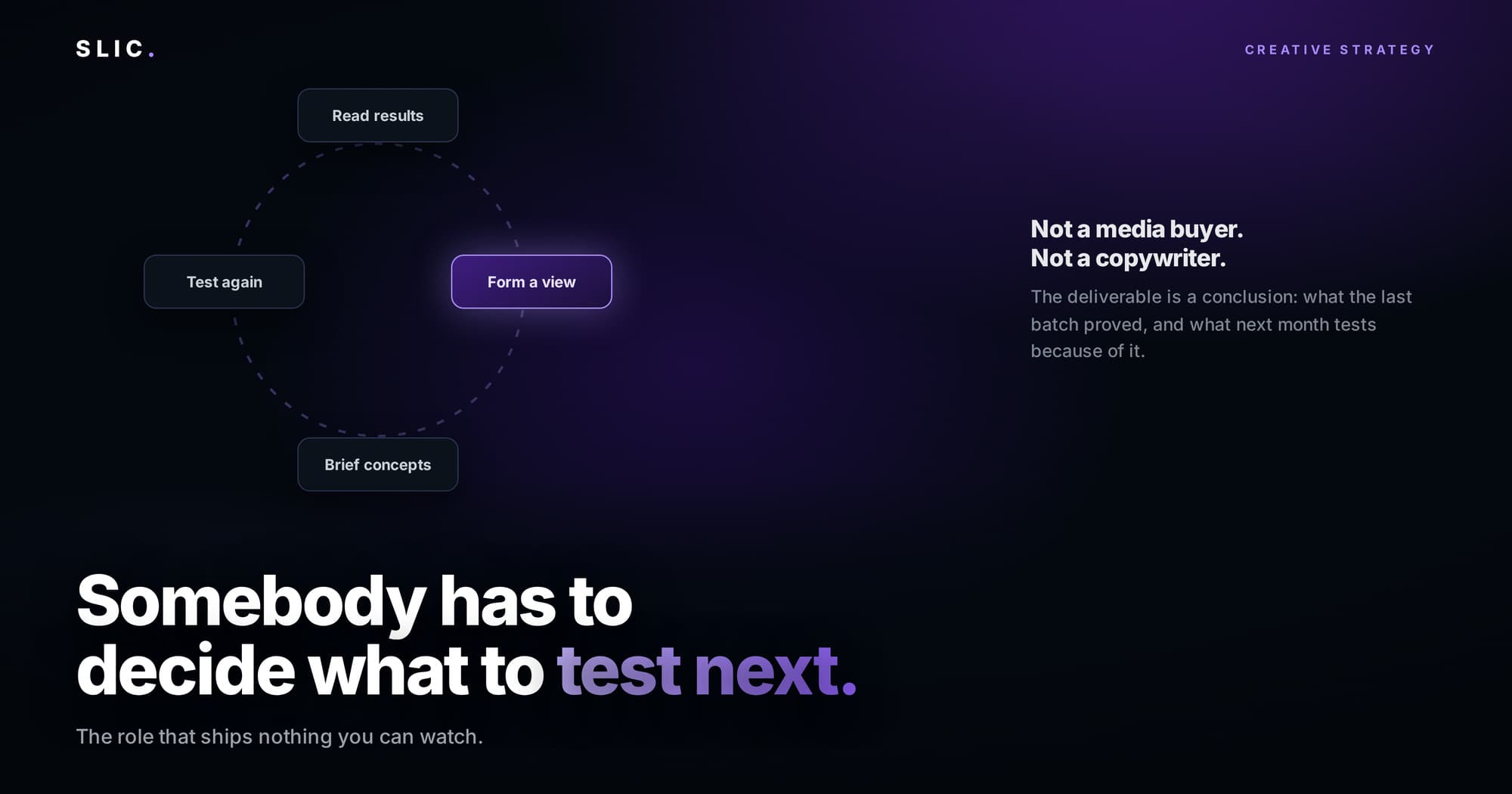
A creative strategist decides what to test next and why. Not what to make, not how to edit it. What question the next batch of ads is answering, based on what the last batch proved.
It is the least visible role in a creative pipeline and the one that most determines whether the pipeline produces winners or just output. It is also the first role brands cut, because it ships nothing you can watch.
What the job actually involves
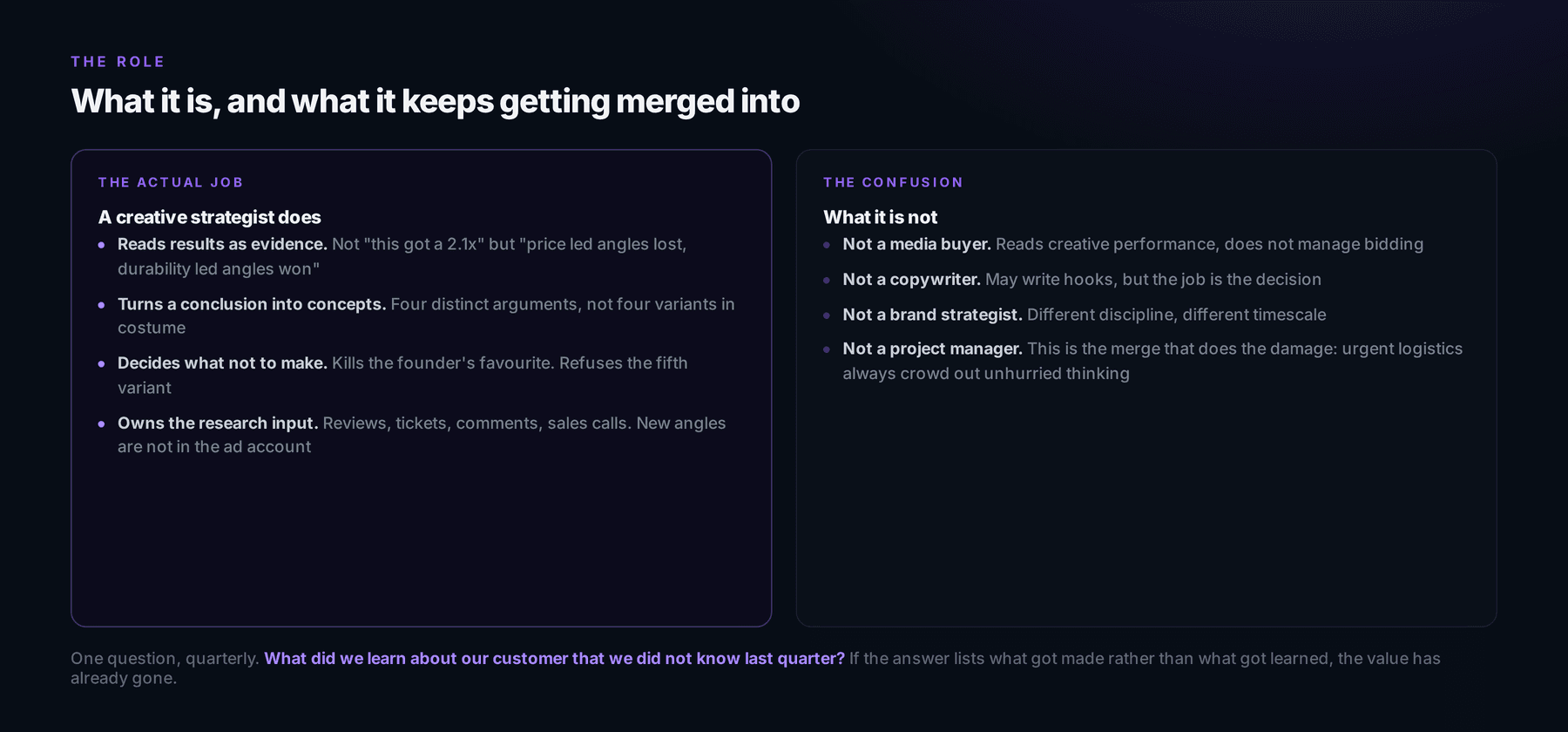
Reading results as evidence, not as scores
An editor sees an ad that got a 2.1x. A strategist sees that all three ads leading with price underperformed and all three leading with durability beat account average, and concludes the audience is not price sensitive.
That conclusion is the deliverable. Next month's briefs come from it.
Turning a conclusion into concepts
Knowing the audience responds to durability is not a brief. Someone has to turn that into four distinct ways of arguing durability, each testable against the others, each different enough that the results mean something.
That translation is where most of the skill sits. It is the difference between four concepts and four variants wearing concept costumes, which is the most common failure in creative testing and the hardest for a client to spot.
Deciding what not to make
Underrated and unglamorous. Killing a concept the founder likes, declining to re-test something that failed in March, refusing a fifth variant of an idea that has already given up everything it has.
Every one of those decisions saves money invisibly, which is why the role is hard to justify with a case study.
Owning the research input
Reviews, support tickets, comment sections, competitor ad libraries, sales call recordings. The raw material for genuinely new angles is almost never in the ad account. It is in what customers say when they are not being marketed to.
This is the part that quietly separates strategists who generate new concepts from ones who recombine old ones. There is no shortcut and it does not happen accidentally.
What the job is not
- Not a media buyer. They read creative performance, they do not manage budgets or bidding.
- Not a copywriter. They may write hooks, but the job is the decision, not the sentence.
- Not a brand strategist. Positioning, tone and identity are a different discipline on a different timescale.
- Not a project manager. Chasing deliverables is real work and it is somebody else's.
Roles get merged constantly, usually into whichever person has capacity. The merge that damages performance most is strategist into project manager, because urgent logistics will always crowd out unhurried thinking, and the thinking is the entire value.
When you need one
Three signals, and you probably only need one of them to be true.
You are testing volume without learning anything. Twenty ads a month and nobody can state what the last quarter proved about the audience. That is the clearest signal there is.
Your concepts have started repeating. New ads that are recognisably last quarter's ideas in different clothes. Usually means the research input dried up.
Spend crossed roughly $30k a month. Below that, a hands on founder or growth lead can often carry it. Above it, creative fatigue moves faster than a part time role can keep up with, and the cost of testing the wrong things starts to exceed the cost of the role.
In house, agency, or neither
In house makes sense when you have enough volume to occupy one full time and enough account access to let them work. Deep product knowledge is the advantage. Category blindness is the risk, and it arrives at around eighteen months.
Agency side makes sense when you want pattern recognition from outside your category. Someone who has watched forty accounts learns things nobody inside one account can. Shallower product knowledge is the trade.
Neither is a legitimate answer under $30k a month, provided somebody is explicitly doing the reading and briefing rather than everyone assuming somebody else is. The failure mode is not the absence of the role, it is the assumption that it is covered.
The full cost comparison, including the parts that never appear in a salary, is in in-house creative or an agency.
How to tell if yours is working
One question, asked quarterly. What did we learn about our customer this quarter that we did not know last quarter?
A working strategist answers it in specifics, with the tests that produced each finding. If the answer is a list of what got made rather than what got learned, the role has drifted into production management and the value has already gone.