Performance video ad editing runs roughly $40 to $150 per asset offshore, $150 to $400 per asset with an experienced freelancer, and $2,500 to $15,000 a month on a specialist retainer. The spread is enormous and per asset pricing hides the number that actually decides your cost, which is how many assets you need.
Almost nobody publishes these ranges. That is not because they are secret, it is because a vague price is easier to defend than a specific one. Here is the honest version.
The three pricing models
Per asset
You pay for each finished video. Simple to understand and the easiest to compare, which is why most brands start here.
Typical ranges: $40 to $150 for offshore editing from supplied footage. $150 to $400 for an experienced editor who works in performance specifically. $500 and up if concepting, scripting and strategy are included rather than just the cut.
The catch: per asset pricing gives everyone involved an incentive to produce assets, not winners. Twenty cheap variants of one dead concept costs the same as twenty across five concepts, and only one of those is worth buying.
Monthly retainer
A fixed fee for an agreed volume, usually with strategy and iteration included.
Typical ranges: $2,500 to $5,000 a month for editing capacity only. $5,000 to $15,000 a month when creative strategy, briefing and iteration cycles are part of it. Above $15,000 you are usually buying dedicated headcount rather than a service.
The catch: retainers only make sense if you can actually consume the volume. Paying for twenty assets a month and testing eight is a straight 60 percent overpay, and it is extremely common.
Performance based
A share of spend, or a fee tied to results.
Typical ranges: 5 to 15 percent of managed spend, usually only offered alongside media buying.
The catch: creative rarely controls enough of the outcome to be paid on it fairly. When the offer or the landing page is the constraint, the creative team is being paid on something they cannot move. Most arrangements like this end badly for whichever side was optimistic.
The number that actually matters
Not cost per asset. Cost per winner.
Take what you spent on creative production last quarter, and divide by the number of ads that carried meaningful spend. That figure is your real cost, and it makes cheap production look very different.
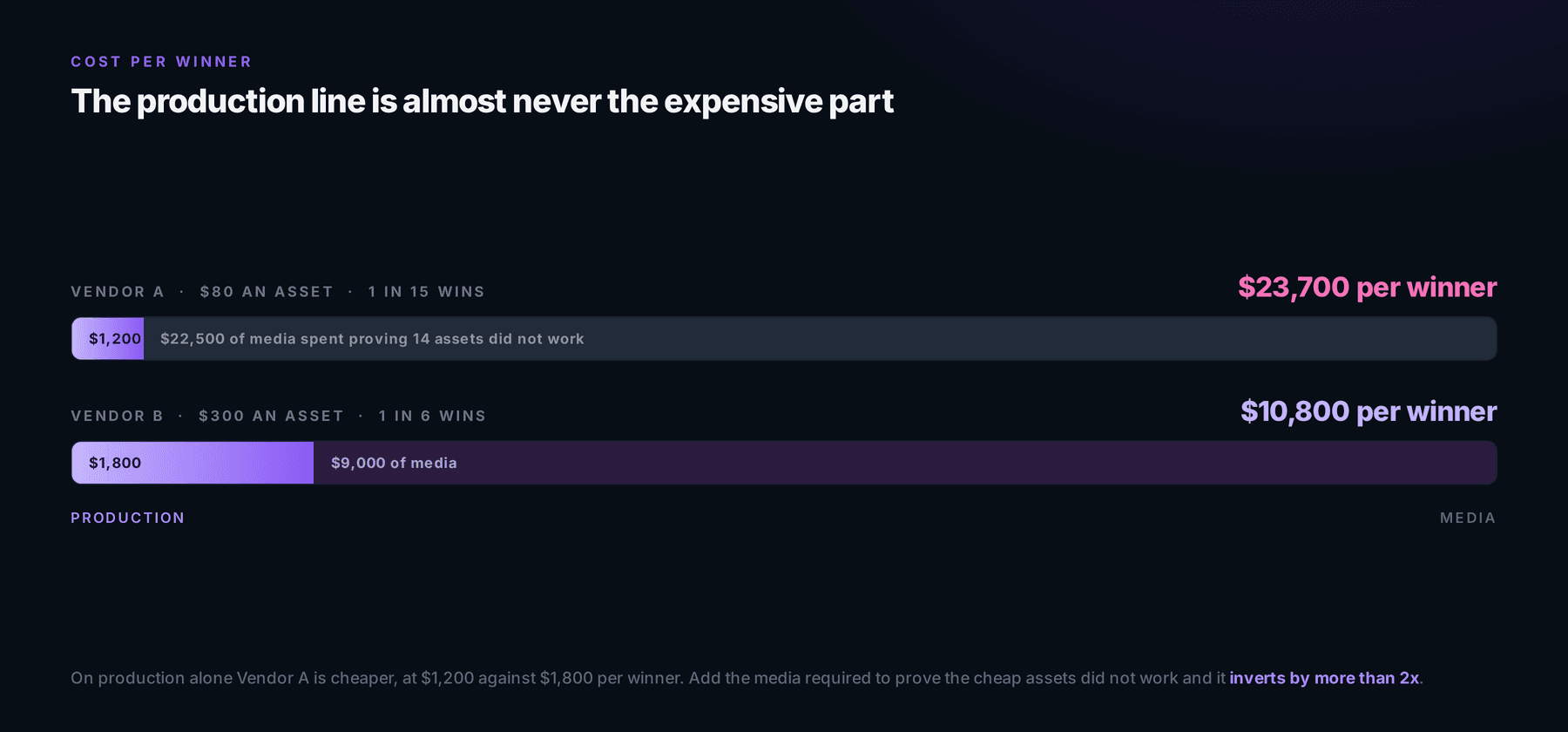
Worked example. Vendor A charges $80 an asset and one in fifteen becomes a winner. Vendor B charges $300 an asset and one in six becomes a winner.
- Vendor A: $80 x 15 = $1,200 per winner
- Vendor B: $300 x 6 = $1,800 per winner
Vendor A still wins on that maths, which is worth being honest about. But add the media spent testing fifteen assets instead of six, at say $1,500 of spend per concept to reach a readable result, and it inverts hard:
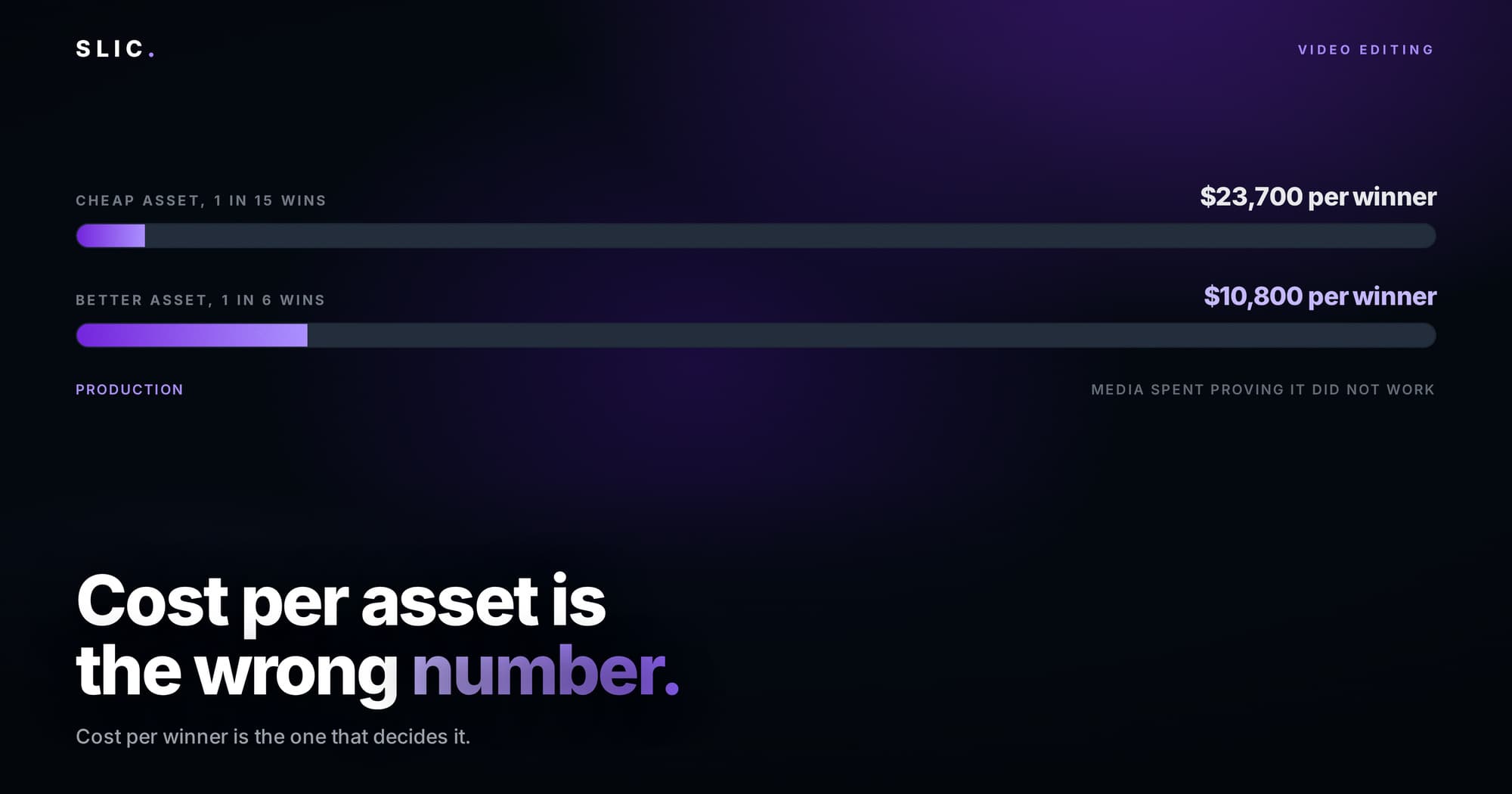
- Vendor A: $1,200 + $22,500 media = $23,700 per winner
- Vendor B: $1,800 + $9,000 media = $10,800 per winner
The production line item is almost never the expensive part. The media spent proving that cheap creative did not work is. That is the calculation most brands never run, and it is the entire argument for paying more per asset.
What you are actually paying for at each tier
At the low end you are buying hands. You supply the concept, the script, the footage and the direction. The editor executes. If your creative strategy is strong and your constraint is throughput, this is efficient and sensible.
In the middle you are buying craft. Pacing, hook construction, knowing which three seconds to cut. Meaningfully higher hit rate on the same brief.
At the top you are buying judgement. Someone deciding what to test, reading results, and changing next month's direction based on them. That is the layer that moves accounts, and it is the layer people cut first because it produces no visible deliverable.
Hidden costs on both sides
Cheap production carries costs that never appear on the invoice: revision rounds, your own team's time re-briefing, media wasted on unusable assets, and delay. If a cheap vendor adds a week to your cycle time, that week has a price. What that price is, is worked through in in-house creative or an agency.
Expensive production has its own: retainer volume you cannot consume, strategy you already have, and minimum terms that outlast your need for them.
How to buy this well
- Price the test, not the asset. Ask what a month of four to six concepts and twelve to twenty variants costs, all in. That is the unit you actually consume.
- Ask about iteration explicitly. Is a hook refresh on a winning ad a new asset at full price, or included. This single term changes total cost more than the headline rate.
- Ask who owns the project files. If you cannot recut your own winner without going back to the vendor, you are locked in regardless of what the contract says.
- Set a three month review on cost per winner. Not cost per asset. If nobody is tracking it, nobody can tell whether the arrangement is working.
If you want the version of this conversation applied to your own account and spend level, book a call and we will run the cost per winner maths with your numbers rather than these ones.